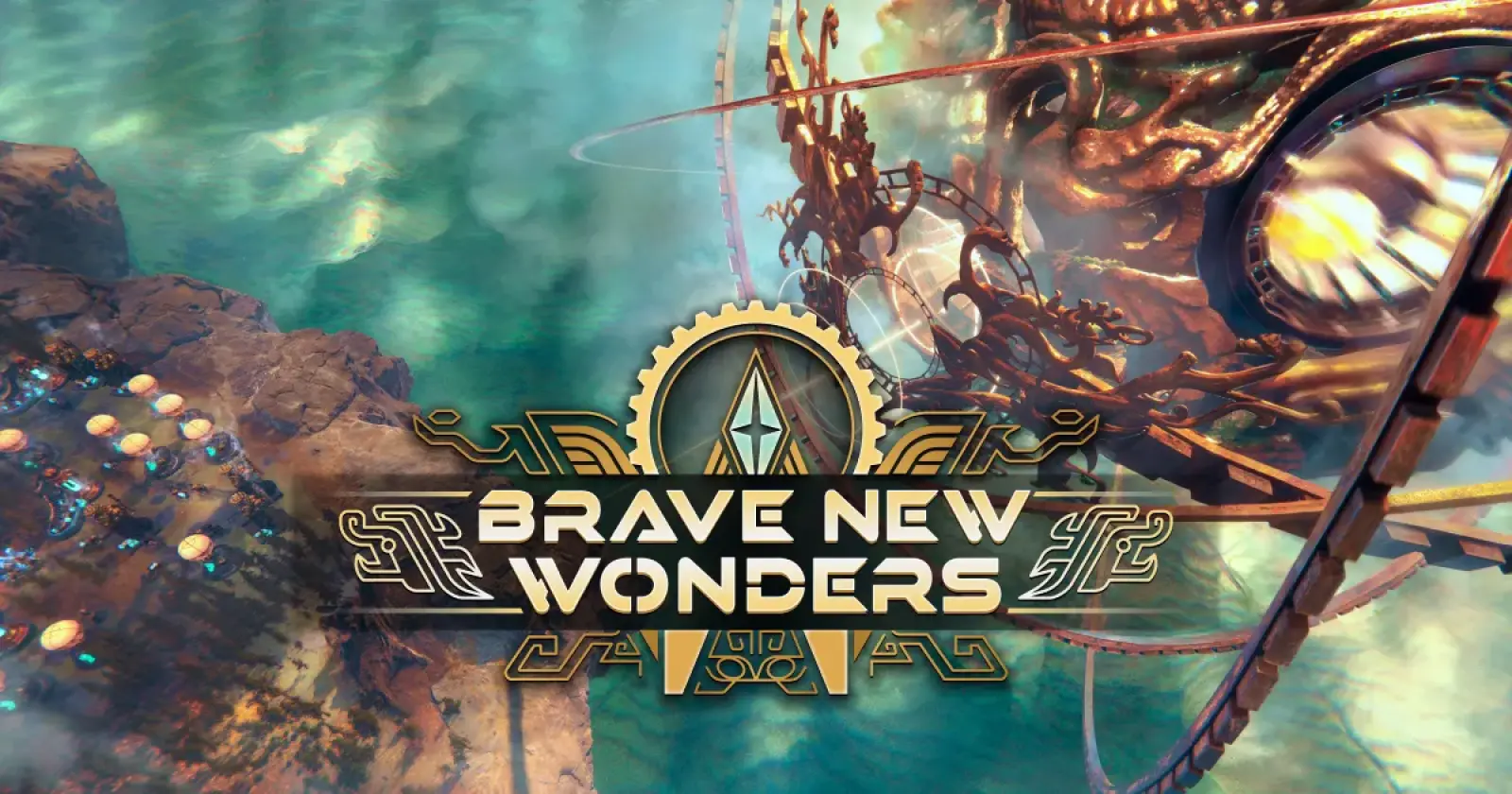
Brave New Wonders is a new factory automation title from the studio City From Naught that combines automation, exploration, and a post-apocalyptic world of floating islands, particularly standing out with its AI text command system that allows players to give instructions to robots in natural language.
We spoke with Shalom Chen, co-founder and CEO of City From Naught, about how the idea for the game came about, the implementation of artificial intelligence, and plans for release.
1. For readers hearing about City From Naugh for the first time, how did the studio first come together, and what pushed the team toward making games?
I went to the University of Waterloo for a master's degree in Electrical & Computer Engineering. Before founding City From Naught, I worked as a Machine Learning Engineer at Google. My cofounder Leon was also an AI director in a tech company. We have always wanted to make video games. At one point, a friend of ours shared that she was being stalked. We managed to track down the stalker, and we found the process surprisingly fun. That experience inspired us to turn it into a video game. The result was Keyword: A Spider’s Thread, a story about a father searching for his missing daughter using various hacking methods. The game was released in September 2021. Since then, we've been making Keyword 2: Nightfall; AI software Marleen that automatically generates 3D textures, and the latest factory automation game, Brave New Wonders.
2. How big is the team currently working on Brave New Wonders?
We have 7 people: 3 developers, 2.5 artists, and 1.5 marketing
3. Where did the idea for Brave New Wonders come from?
The idea came up during fundraising. We were introducing our background to an investor. We have done multiple games, and we are very strong on AI backgrounds. One of the investors asked, “Why don’t you combine the game and AI together?” That question really sparked the beginning of Brave New Wonders. We started looking into factory automation games, we love the genre. It’s very indie-friendly and has a strong, dedicated community. While researching, we came across an early access title that uses robots to transport materials instead of conveyor belts. In the reviews, a lot of players were complaining about how difficult it was to program the robots, it was overly complicated, and the learning curve was steep. That’s when it clicked for us. This is exactly where large language models can help. They’re great at understanding player intent and generating instructions, so we decided to integrate LLMs into the game to fill that gap and make the experience much more intuitive and accessible.
4. How long has Brave New Wonders been in development so far, and how close do you think the current version is to what you first imagined?
We’ve been developing the game for roughly a year and a half. I think it matches everything we originally imagined. The text command system, based on a large language model, is extremely efficient and very easy to work with. Overall, development has been much smoother than we expected. This project is also very different from our previous games. At the beginning, development on a simulation game is very slow. It took us a couple of months to set up the basic infrastructure, and another couple of months to complete the first island. After that, however, everything sped up very quickly. It took only about half as much time to complete the second and third islands. Overall, the game is very close to what we imagined.
5. After playing the demo, it feels pretty different from most automation or colony sims. What do you think the game adds to the genre that players haven't really come across before?
Most factory automation games use conveyor belts. Only a few use robots for transportation. Robots are flexible, but they are usually very hard to program or coordinate. We looked at one game that highlights robot movement, and in the comment section, many players complained that the learning curve was steep. They found the system hard to program and overly complicated. That was the moment we felt, “Okay, this is a perfect case for a large language model to step in,” because LLMs are very good at understanding player intent. So we added a text command system to Brave New Wonders, which makes the game truly unique among factory automation games. The challenge is that this feature is one of a kind. It is the first large language model implementation of its kind in this genre, so players do not have an existing reference point for how to use it. To address this, we developed extensive tutorials to help players learn the system. Once they get the hang of it, it opens up a whole new world of possibilities for them.
6. One of the most interesting aspects of the game is the AI-style command system. Could you walk us through the creative and technical process behind designing that mechanic?
The inference runs in the cloud. Large language models require a significant amount of memory, and they would also compete for memory with graphics rendering, gameplay systems, and other processes. This means most players’ PCs would not be able to run both the game and the model locally at the same time. However, there are ways to reduce the memory footprint through techniques such as model distillation. We are believers in the Stop Killing Games initiative, and we will do our best to eventually allow players to run the models themselves, even on moderate hardware. Because the model currently runs in the cloud, internet access is required when using the AI command system. When a player enters a command, we send it to the server, where the large language model interprets what the player wants to do and translates it into a formatted JSON block that the Automatons in the game can understand and execute, and then send it back.
7. Games with complex systems can sometimes feel overwhelming for new players. How are you making Brave New Wonders easy to learn while still keeping it interesting for experienced players?
That is very true: factory games can easily overwhelm new players. We have iterated on many different versions of our tutorials to help players ramp up. We observed that players who have spent time with Factorio, Satisfactory, and other factory games can pick up our game easily, often without even reading the tutorial. However, we want more people to enjoy this genre. To support new players, we added more guided instructions at the beginning so they can follow along step by step. We also integrated a hint system, so even if players get stuck or miss a few tutorial spotlights, they can still progress through the challenges. For experienced players, we integrated tutorials into tasks, so they can continue making progress and completing achievements while learning the game.
8. The game has a very specific vibe and world. Could you tell us more about games story and lore, and do they matter to the way people experience the game?
The game begins with people waking up in the dark, thousands of years after an apocalypse. They wake up with no clear understanding of what happened in the past. At first, they have only limited technology, but over time they begin to develop their own tools, systems, and ways of surviving. As they explore the world, they try to uncover what happened to their ancestors. They discover relics from lost civilizations, along with signs of global warming, natural disasters, and technological failure that contributed to the collapse of the old world. The story and lore matter a lot to the way players experience the game, because exploration is not only about finding resources or expanding factories; it is also about piecing together the memory of a broken world. In the final stage of the journey, the player brings these fragments together. The floating cities, forgotten machines, ancient biotechnology, and lost technologies of the Old World are no longer treated as separate relics of failed civilizations. Instead, they become the foundation for a new future. By building Wonders, restoring connections between islands, and choosing how different factions cooperate or conflict, the player helps shape what civilization will become next. The ending is not about returning the world to what it once was. That world is gone. Instead, Brave New Wonders concludes with humanity accepting that survival cannot come from domination, isolation, or blind faith in technology alone. The final Wonder becomes a symbol of that belief. It rises above the endless sea not as a monument to power, but as proof that even after collapse, people can still create beauty, meaning, and hope.
9. When can players expect Brave New Wonders to officially launch?
We will take part in Steam Next Fest this coming June, and we are aiming for an official release around September.
10. Which platforms are you currently planning to release Brave New Wonders on?
We're looking at Steam PC only.
11. Finally, is there anything you want to say to the fans who have been following the project and supporting you all this time?
Thank you for your support and feedback. It takes a lot of patience to go through all of those early, unpolished mechanics, and your feedback helps us refine the game and make it better for everyone else. It means a lot to us.











-hero.webp)