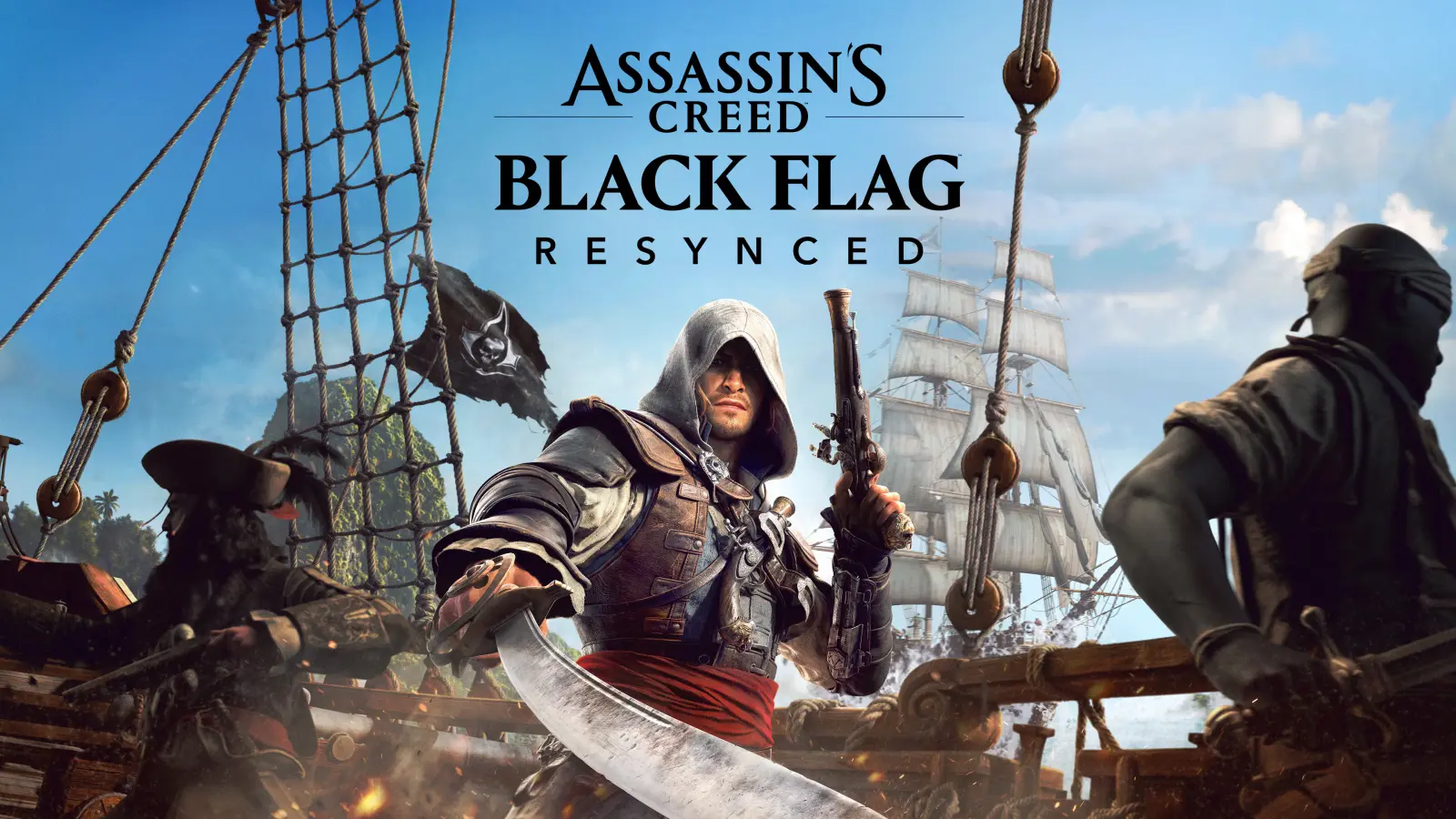
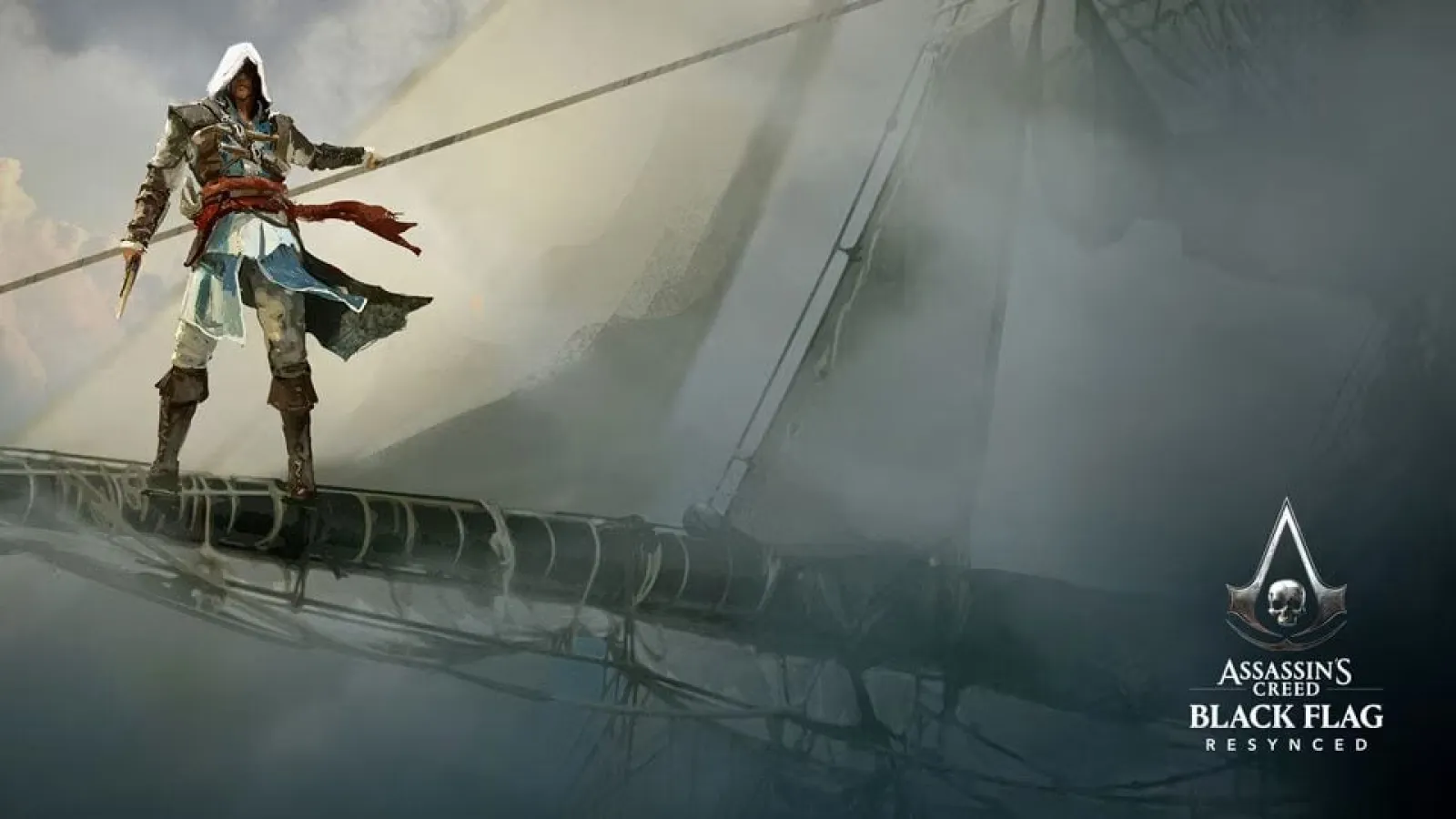
Assassin’s Creed Black Flag Resynced
✅ Prednosti
- The feeling of sailing is fantastically captured
- Modernized presentation and fluid movement
- Better mission rhythm compared to modern titles
- Additional content and expanded stories of known characters
- Stable performance on PC with high quality
❌ Nedostaci
- Stealth is not perfect, can be unconvincing
- NPCs sometimes stand still waiting to be removed
- Camera occasionally catches odd angles
- Some modern segments are removed, which may disappoint
- Lacks depth in tactical approach to stealth
Yo-ho-ho, the black flag is flying again. After years of major RPG sequels, Ubisoft is returning to one of the most beloved chapters of the series!
Black Flag was already a slightly different sequel back in 2013. The assassins, templars, and historical conspiracy that spans several layers of fiction are still present, but Black Flag has been remembered from day one primarily as a pirate adventure. Sailing the ship, treasure hunting, naval battles, and that feeling that something new and wild awaits beyond the horizon. Realistically, we all love playing as pirates, and Black Flag hit that fantasy almost perfectly.
That's why Resynced has a rather thankless task; it not only needs to look better but must also bring back that specific feeling of the original while simultaneously appealing to an audience that has since played more modern sequels and gotten used to different mechanics and presentation. If it changes too little, we just get a prettier old game; if it changes too much, we lose what made Black Flag beloved in the first place.
Fortunately, Resynced is a remake that understands why the original was special. It's not just a cosmetic return to the Caribbean but probably the best way to play Black Flag today. The old magic is there, but the presentation is more modern, movement is smoother, combat has been revised, stealth feels more natural, and the sea looks so good that sometimes it's enough to just raise the sails and let go of your worries.
There are also more concrete changes in the content. The modern era, or Abstergo segments, are no longer present in the same form. Instead of ejecting players from Edward's story into an office stroll through the contemporary world, Resynced shifts the focus back to the Caribbean and Edward's adventure. Personally, I think this is a good decision, as the original modern segments today feel like remnants of a broader Assassin’s Creed story that has diluted quite a bit over the years.
The remake also brings additional content in the pirate era itself. The stories of some familiar characters like Blackbeard and Stede Bonnet have been expanded, new officers appear on the Jackdaw, new dialogues and cutscenes have been added, shanties and activities, a whole new final chapter, and underwater exploration has been expanded through freer diving and new locations.
The Caribbean at its best
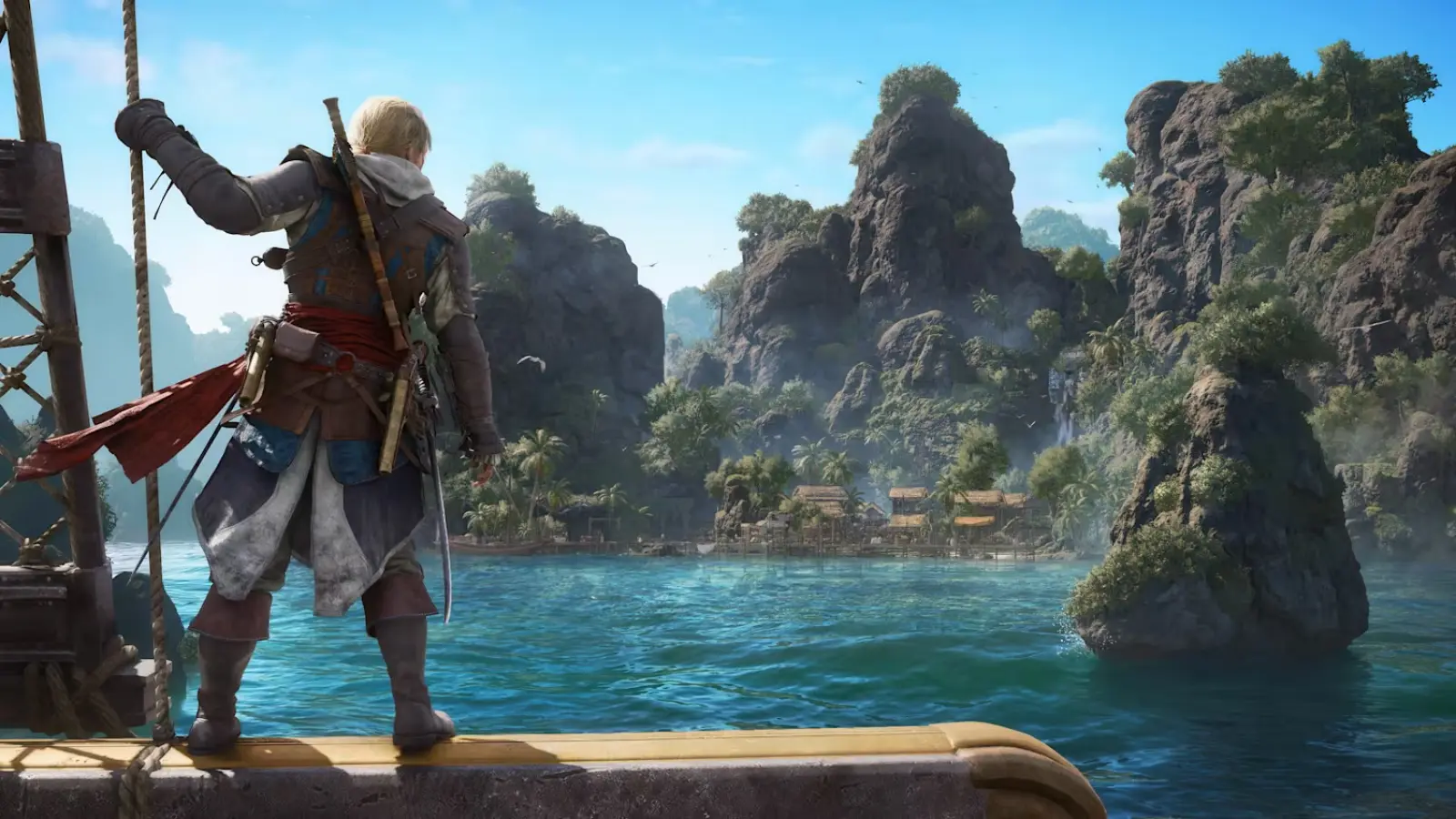
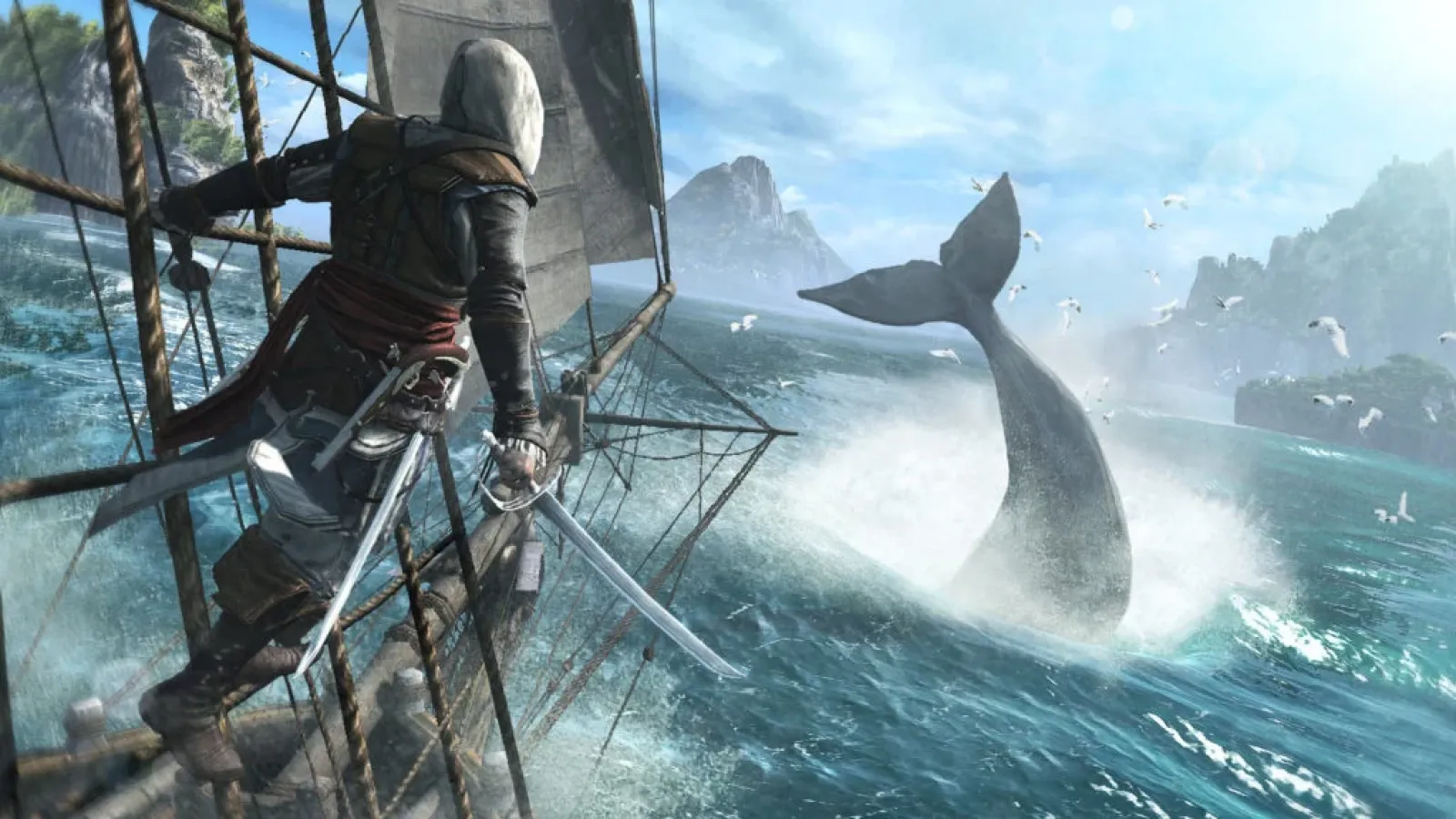
Visually, Resynced is easiest to describe in one sentence: these are the Caribbean in their best form. The sea is the absolute star. Foam, reflections, waves, fire on the water's surface, ships cutting through the ocean, and the changing light as you sail create the impression that a tremendous effort has been put into exactly what Black Flag needs to sell the most: the feeling of sailing.
Ubisoft has rebuilt Black Flag on a newer version of the Anvil engine, with a completely revamped visual presentation, ray tracing, better lighting, denser vegetation, more modern animations, refined combat systems, smoother parkour, and stealth that finally includes crouching.
I am surprised at how smoothly the game runs on PC, with 4K, DLSS Quality, ray tracing, and max settings. The framerate is stable, with no noticeable drops, and the technical impression remains very good. Reflections on the sea, detailed textures, vegetation density on the islands, and the architecture of cities like Havana and Tortuga stand out, and the sky has never looked so realistic in AC games. In high sails mode, when the ship cuts through the sea at full speed, the game can look almost like a documentary, just with more cannons.
The Caribbean is not just a beautiful backdrop, but a space that constantly calls for wandering and exploration. The deserted islands hide treasures, secrets, and game animals. Here are the sea shanties of your crew, the so-called shanties that you chase across rooftops and branches as if your life depends on it, shipwrecks that you explore with the help of an underwater bell, Mayan stelae, maps that lead to hidden treasures, and fortresses and ships just waiting to be plundered. The map has a lot of content, but it doesn't feel like someone just spilled quests all over it. The activities are clearer, more compact, and mean more than in the bloated RPG sequels.
This is one of the biggest advantages of Resynced. Ubisoft has taken useful elements from the modern Assassin’s Creed games but has not carried over their bloat. There’s no feeling that the game constantly buries you under endless quests and numbers for the sake of it. You can simply sail, steer towards something interesting, attack a ship, clear an island, catch a shanty, or head towards the main mission.
A true remake, not just a remaster
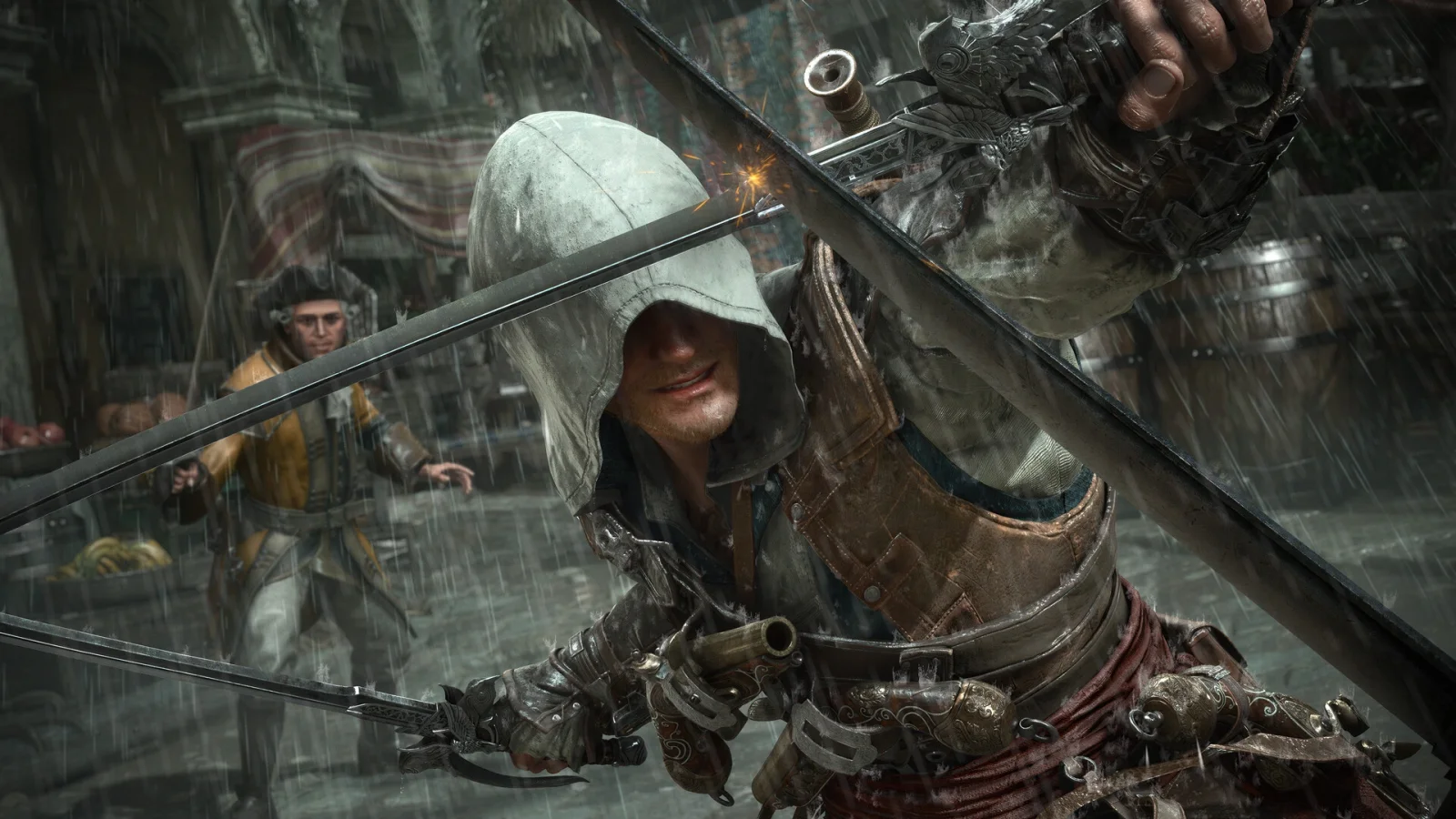
The visual upgrade is obvious, but the biggest difference is in how the game plays. Movement is smoother, parkour is more fluid, stealth has been modernized, and combat has a completely different rhythm. This is still Black Flag, but it doesn’t feel like a game from 2013 that has just been run through a high-resolution filter.
Parkour works very well. Edward climbs, jumps, and moves through the environment quickly, and the islands, cities, and ruins once again have that classic Assassin’s Creed sense of verticality. Occasionally, there are moments of snagging while climbing or grabbing the wrong surface, but generally, movement is enjoyable.
Stealth has also received an important change: Edward can now crouch. It sounds trivial, but moving through vegetation, cover, and enemy spaces immediately feels more natural. Resynced still retains the familiar stealth DNA of the series, with bushes, positioning, hidden kills, double assassinations, and using the environment, but adding crouching makes the whole system less rigid compared to the original.
However, stealth is not perfect. This is still that good old Assassin’s Creed stealth where you can run past an enemy almost in front of their eyes, disappear into the bushes, wait for them to check what’s going on, and then take them out. Then two more come to see where the first one disappeared, and they end up the same way. It’s fun, fast, and has that old charm, but it’s not particularly realistic or tactically deep. NPC pathing could have been a bit more convincing, as some enemies often just stand around waiting to be taken out, and when everything goes wrong – there’s the omnipotent whistle that will always draw them into the bushes, and then to their death.
Mission structure has a better rhythm than modern titles
One thing I particularly appreciate is the mission structure. In newer RPG sequels, everything can feel stretched out and designed as part of a huge content machine. Black Flag Resynced has a tighter, more concrete rhythm. Many missions feel like small set pieces, more carefully staged and clearly conceived.
Assassinations are a good example. In older Assassin’s Creed games, they often had the feel of a small event, a moment that you approached through the mission, location, and setup. Something you planned carefully. In newer sequels, such moments can get drowned in the broader open-world flow. Resynced brings back some of that feeling. Not every assassination is just another marker, but often part of a clearly set scene.
An important modernization is the approach to parts where you have to track and eavesdrop on NPCs. Such segments still exist, but they are no longer the old instant-desync penalty if something goes wrong. If you are detected or tracking goes awry, the game often offers an alternative solution, such as combat, or the NPC starts running away from you and you have to find them again. This preserves the idea of the original, but removes some of the frustration. Thank you for that, Ubisoft; “repeat five minutes of walking because you turned the wrong way” has never been the pinnacle of game design.
Edward fights dirty, and it suits him
The revised combat system resembles newer installments in that parry, dodge, attack reactions, and the opponent's defense bar play an important role, but the pace is faster and less burdened by RPG numbers. Enemies have health bars, but they are not sponge-like. They fall quickly, combat is fluid, and Edward feels like someone who fights not honorably, but effectively.
It suits him perfectly. Edward can sweep an enemy's leg, knock them to the ground, and then finish them off. He can slam them into a wall and perform a takedown. He can use pistols, different types of swords, and a rope to pull opponents towards him or stagger them. You get the rope significantly earlier than before, which immediately opens up more options in combat and movement. The hidden blade is no longer a standard weapon in open combat, but part of assassinations and takedowns, but that didn't particularly bother me.
However, I have a few remarks. The camera occasionally catches a weird angle, especially during takedowns, where it can spin around Edward for 180 degrees for no apparent reason. Some prompts are also not always perfectly clear. Edward can use an opponent as a shield, which depends on the situation, mainly when an enemy is shooting at you, but it doesn't feel completely consistent. Also, sometimes I felt like I pressed parry or dodge in time, yet I would still take a hit. Maybe part of it is timing, maybe a skill issue, but the feel is not always perfectly precise. Nevertheless, combat is generally fun. When it clicks, it's fast, brutal, and fits Edward's character well.
Resynced smartly avoids turning Black Flag into a full-fledged RPG. Edward can buy and change swords, pistols, and clothing, and equipment has its stats, but the game doesn't overwhelm you with new loot every five minutes. There are no skill trees or endless number comparisons, while outfits are mostly aesthetic. Crafting exists through upgrades to Edward's health, ammunition, and basic capacities, and there are also little things like trinkets that carry certain stats, but all of this remains simple enough not to choke the game's rhythm.
The sea and Jackdaw remain the heart of the game
No matter how important everything else is, Black Flag lives or dies at sea.
Hoisting the sails, listening to the crew sing shanties, and heading towards some ship, island, or fort simply has a special appeal. Naval battles are excellent and remain one of the strongest parts of the game after many hours. There is a real sense of superiority when you upgrade Jackdaw well, attack multiple ships at once, set the sea on fire, hit a target with a mortar from a distance, or ram into an enemy ship and finish the job up close.
Jackdaw upgrades are tangible and important. If you ignore them, more serious opponents like frigates and larger ships will quickly sweep you away. Regular investment in the ship is not just cosmetic, but directly changes how safe you feel at sea and what conflicts you can survive.
Fortresses are an excellent test of everything that Black Flag does well. First, you break the ship's defenses, avoid cannon fire, look for the right angle of attack, and use everything the Jackdaw has. After that, you enter inside and fight on foot. This transition from naval chaos to land combat nicely connects the two faces of the game.
Boarding a ship is a slightly weaker part of the game. It is still effective, but the structure repeats itself. You latch onto an enemy ship, kill enough enemies, and collect loot. Once you get into the fight, it’s still fun, but it’s not particularly different from attack to attack. Sometimes I just sank the ship and picked up the materials. This is definitely one of the parts where repetitiveness is most felt.
Characters carry more than one story
Edward Kenway is one of the most charismatic protagonists of the series, but he doesn’t carry the entire story on his shoulders. The reason we love him is that he is not a typical hero. He is not a character who immediately talks about principles, morality, and great ideals. He is cynical, self-assured, selfish, and above all, looks out for himself. He wants money, status, fame, and proof that he is worth more than the world has assigned him.
That’s exactly why his story works, because there is room for growth. Edward is not interesting because he is right from the start, but because the people around him, events, and the consequences of his decisions slowly change him. His relationship with Kidd is an important part of that. Kidd is not just a side NPC who pushes the story, but someone who shapes Edward's path to the assassins and constantly confronts him with ideas that he mostly dismisses or mocks at the beginning. Their relationship is one of the more beautiful parts of the story.
Adewale is also a great example of a character who feels natural in the game world. A black slave in a world of whites who helps Edward steal a ship and becomes his first officer. His position, dialogue, and presence on the ship do not feel forced, but like an organic part of the historical and pirate context. The game does not use him as decoration or a message, but as a person who belongs to that world and whose presence carries weight.
The supporting cast is generally strong and gives the world breadth and character. Captain Blackbeard stands out here in particular. His monologues have weight, threat, and theatricality, but never feel like a caricature. He is definitely one of the better-written characters in the series, and each of his scenes carries a special energy.
The story is therefore much stronger than one might expect from “that pirate Assassin’s Creed game.” Yes, the atmosphere and gameplay are a big part of the appeal, but the story constantly pulls you forward. You want to see where Edward goes, how his relationship with the assassins will develop, and what will happen to the crew around him.
Technical state and minor issues
Technically, Resynced is in very good shape. Performance is stable, the game looks excellent, and I didn’t experience any crashes. There were a few minor bugs: clipping in dialogues, one strange texture bug on the sea, a situation where I jumped into the sea and ended up swimming inside the skeleton of a ship with no clear exit, and occasionally strange camera and prompt behavior. None of this seriously spoiled the experience, but it’s worth mentioning.
Facial animations are a pleasant surprise. The main characters gesture more naturally, have more character, and the voice acting is excellent. After some of the newer Ubisoft games where faces tended to look wooden, here the main cast functions significantly better. The minor, irrelevant NPCs passing through the city are a bit less detailed. If you look at them up close, they appear stiffer, the animations are simpler, and the world sometimes loses a bit of the illusion of life. But during normal gameplay, this is not a big problem.
The best Assassin’s Creed for old and new fans?
What makes Resynced particularly successful is the way it combines two eras of the series. It brings back the classic Assassin’s Creed feel for old fans, with more concrete missions, parkour, stealth, and a clearer structure. For newer fans, it offers a more modern presentation, smoother combat, better movement, a prettier world, and a more accessible pace.
Therefore, this is a title that could appeal to almost everyone: old fans of the original, newer fans of the RPG era, and people who might just want a great pirate adventure. If you love Assassin’s Creed games, it’s hard to imagine that you won’t enjoy this return.
It’s modern to hate on Ubisoft, but Ubisoft isn’t the only one that likes to repeat a proven formula. The difference is that Black Flag Resynced shows how that formula can work again when the right title is pulled from the vault and treated with enough care. This was a smart move at the right time.
If this is the direction Ubisoft wants to take with remakes, I think we can justifiably hope for Ezio’s trilogy, Altair, or some other sequel in a new guise, and after this, I’m even cautiously optimistic about Hexe.
Conclusion
This is the definitive Black Flag. The game does not erase the identity of the original but modernizes it enough to feel fresh today. It looks beautiful, plays comfortably, the story and characters still carry weight, and the pirate atmosphere hits hard once again.
For old fans, this is a return to the Caribbean that they probably wished for. For new players, it might be the best entry into what Assassin’s Creed once knew how to be. And for Ubisoft, this is a reminder that sometimes you don’t have to reinvent the wheel, or rather, the new ocean. It’s enough to set sail again on one that was already great.
A copy of the PC version of the game for review purposes was provided by the publisher Ubisoft











-hero.webp)