Revenge is only the beginning
A young man who lost his father. That’s how Burden of Revenge begins - and exactly how it pulls you in. Finn Goldenhorn sets out into the wilderness with a single goal: to hunt the vicious beast responsible for his father’s death and settle the debt. On his hand he wears his father’s magitech Gauntlet. It's a weapon and an inheritance, hungry for the power of Everseeds, ancient magical artifacts buried in the realm ahead. That realm is Tempelheim: forgotten, dangerous, and.
But the game does promise what the best revenge stories always deliver: the deeper you go, the less things stay stays black or white. Hunting the killer, Finn begins to uncover long forgotten history which challenges everything he believed about the world; his enemies; and himself. Revenge is the fire in Finn's heart, but it is never simple. He must carry the weight of grief, guilt, and a history he never asked for, alone.
You set out for revenge. You stay for the truth be.
What Burden of Revenge actually is
By genre, this is a story-rich, single-player third-person action-adventure game. Plainly speaking, you solve puzzles, jump on stuff and fight bad guys in 3rd person. The thing which makes this special is how the basic mechanics work together - traversal, combat and puzzles. You leap, grapple, climb and fight through environments built around fluid movement, where solving a puzzle often means surviving a fight, and the path forward is almost never a straight line.
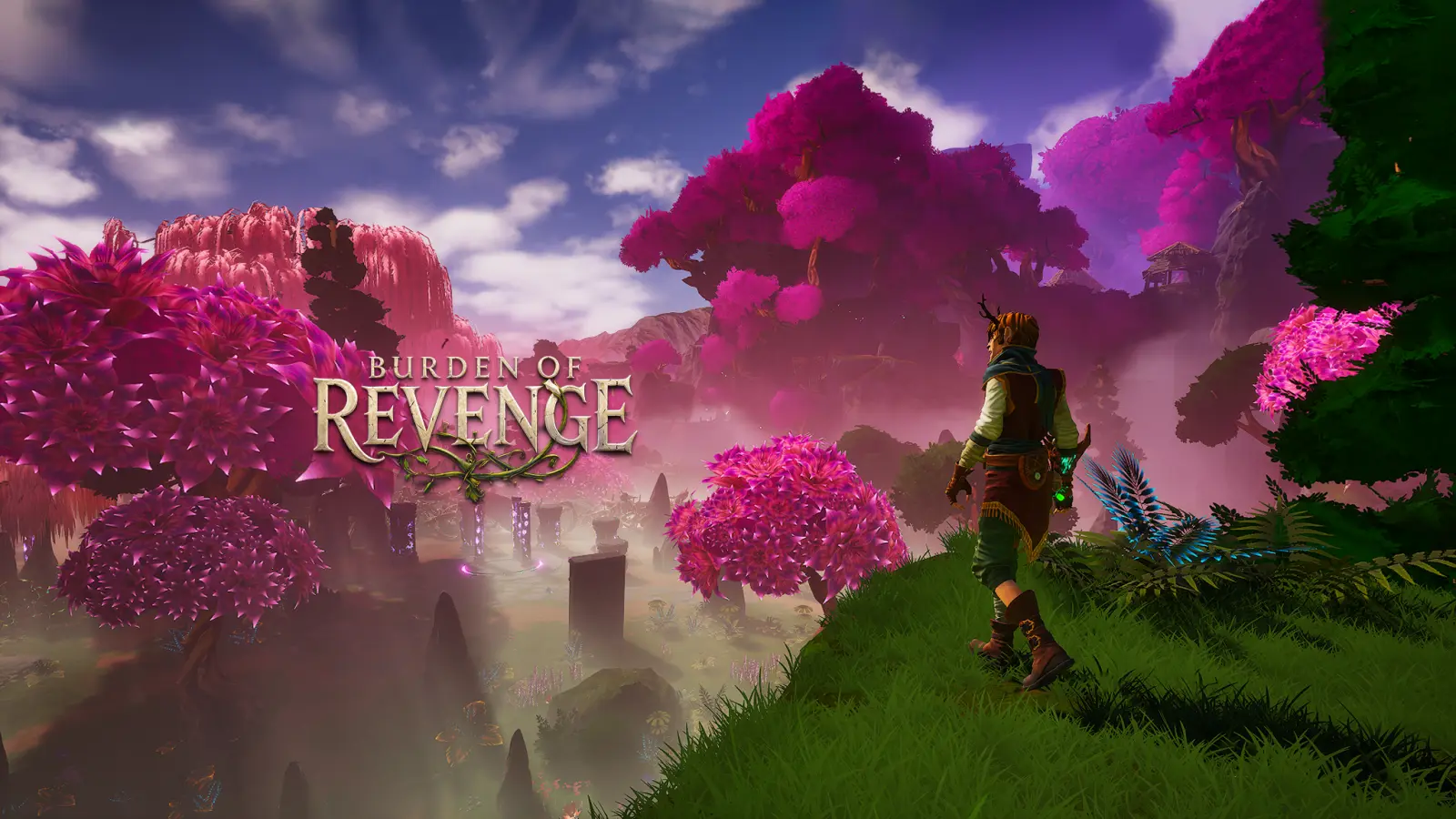
The visual direction is stylized naturepunk: vibrant magical nature collides with the remnants of old industry and war. Huge Temple Trees rise above the forest canopy, ruined magitech structures are swallowed by vines, and poisonous flower fields glow in colours that lure you closer than you should go.
Tempelheim is a world where history never vanished, only grew over
Burden of Revenge is set in the world of Sylvaris, a high-fantasy naturepunk settingworld where ancient magic, living forests and a magitech civilization co-exist. The main area of action in this beautifully crafted landscape is Tempelheim. Region far on the western border of the Deerian Empire, also known as the “Land of the Five Trees”, or simply just “the Borderlands”.
Tempelheim was once shaped by five powerful Everseeds. They are ancient sources of magic which root themselves into the land and gave rise to massive Temple Trees and magical biomes. Centuries ago the Deerians and the Sylvanites fought a devastating war over control of the Everseeds. It ended when the Sylvanites raised the Rose Wall, a vast barrier of root, thorn and vine that cut much of Tempelheim off from the outside world, leaving the small Deerian city of Ivy Town to guard the border.
Since then Tempelheim has become beautiful but unstable and dangerous. The forest can seduce you with its beauty, but the ruins are dangerous. Old Deerian roads, statues and abandoned engineering works are still scattered through the wild, slowly being swallowed by magical nature. This is a world where history is physically present in the landscape - even when it’s meaning remains a mystery.
The Everseeds are the heart of the world and the goal of the journey
The Everseeds are the central magical objects of the game and the main objective of your journey. They originate from the Aether Tree, a metaphysical World Tree connected to both the spiritual and the mortal planes. When an Everseed is planted, it becomes the magical heart of a region: it roots magic into the land, grows into a massive Temple Tree, and shapes the environment according to its nature.
The everseeds each take root in land and shape each region giving it a unique identity. So by region you would encounter growth and vines, flowers and poison, water and flow, fungi and decay. As a side-effect, the Everseeds produce Everseed Tears, Crystalline formations far safer than the raw magical power of each Everseed. The Tears were used as magical conduits for the Deerians, the fuel of their magitech; for the Sylvanites, they are a part of the land’s spiritual life.
The Gauntlet, four powers and a dance through the landscape
Over the course of the game, thanks to the unique nature of your father’s magitech Gauntlet, you will get the chance to absorb the power of four Everseeds and switch between them as needed in order to get through puzzles and overcome your enemies. Combining them unlocks ways to move around in different ways and manipulate the landscape, move objects, discover hidden paths, climb, grapple, leap, clear obstacles, and fight.
This is where Burden of Revenge shows its ambition: platforming, combat and environmental puzzling are not separate modes, but a single mechanic which fluently combines them into one magnificent traversal.
Six hand-crafted regions
Instead of one large open world, the game is structured as a series of hand-crafted adventure regions. Each is a focused exploration space with its own visual identity, magical theme, hazards and a major Temple tied to one of the Everseeds. Verdantis is the first region inside Tempelheim and teaches you how to explore a region and find a way into the first Temple. On that path you will face its Guardian and claim new power.
Florsica is a place of beauty and danger: colourful flower fields, poisonous plants, thorny paths, hidden settlements and old battlefields swallowed by green. From a distance it feels enchanting, but the deeper you go the more real the threat becomes. Florsica turns beauty into tension - you are constantly asking yourself whether the landscape is inviting you forward or luring you into a trap.
Hydrielle is built around water, lagoons and broken Deerian engineering projects. Mycellix is darker and stranger - fungi, underground spaces and transformation. The Sun Region is the magical centre of Tempelheim, where the land feels dreamlike and unstable, and beyond the wall are the Sylvanite Wildlands. The maps are designed to feel dense rather than empty: the goal isn’t space for its own sake, but memorable regions where every landmark tells you something about the world.
Temple Guardians and the creatures of Tempelheim
The path to each Everseed is guarded by danger. You battle dangerous creatures and towering Temple Guardians in fast-paced encounters built around movement, timing and mastery of the Gauntlet. The bosses aren’t just walls of health but spatial puzzles in motion where each Guardian embodies the nature of its region, from the floral horror of Florsica to the luminous fungal colossus of Mycellix. You really need to figure the fights out in order to pass it.
Deerians and Sylvanites - a war with no clean winners
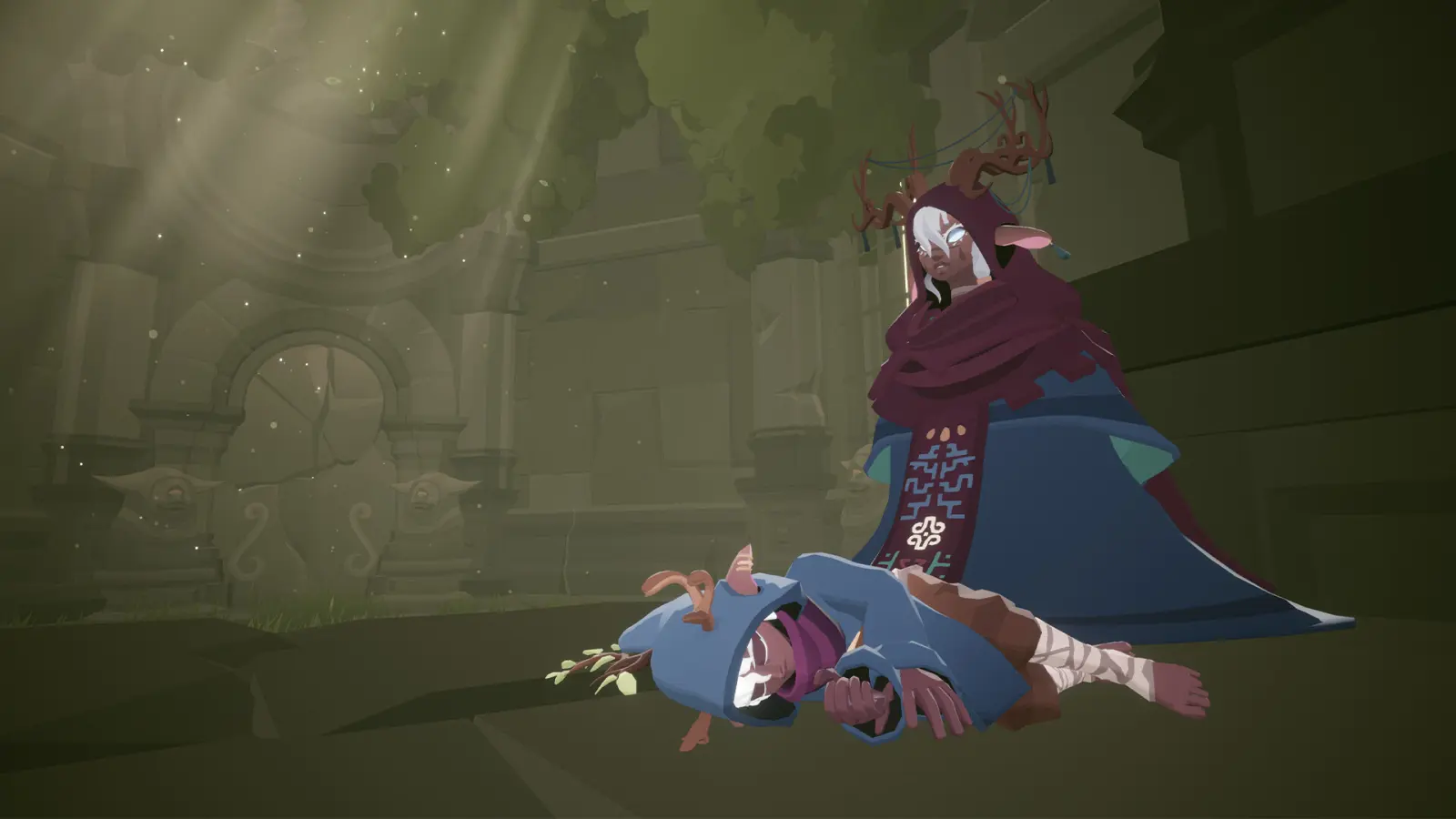
The greatest strength of the games world may be precisely in its refusal to give an easy answer. The Deerians are a mortal civilization known for architecture, scholarship, engineering and magitech; they value order, reason and progress but they are an imperial society which requires vast resources to power their civilization. The Sylvanites are ancient magical beings, plant-like, covered in bark, vine, thorn and root; not monsters, but a people with their own history, traditions and a deep bond to the Everseed network.
The ancient war is remembered differently depending on who tells it. Deerian accounts describe the Sylvanites as dangerous and territorial; Sylvanite memory, where it survives, treats the war as a catastrophe born of the misuse of the sacred. The game offers no clean answer. Nor are the factions binary: the Empire, the borderlander Deerians who live right up against the danger, isolated Sylvanites, hidden settlements and the remnants of older communities - a world where many people are living with the consequences of a war that never truly ended.
From Tuzla, for the whole world
Behind it all is Saltium games, a development studio from Tuzla. What makes this project so exciting for the regional and indie scene isn’t just its production values, but the ambition of the idea: this is not a small tech demo but a complete world with its own mythology, peoples, factions and economy of magic. Naturepunk here isn’t a mere visual filter but a recognisable identity, the kind of clear creative vision that can push a game from this part of the world onto the global stage. I hope we will be seeing more and more games out of this studio because such nicely crafted and visually creative landscapes are really hard to find.
How, where and when
Burden of Revenge is coming to PC via Steam, for now it’s in the early alpha stage. It is single-player, in English (interface, voice acting and subtitles), with Family Sharing support. We were able to run the alpha build on an older mid-end PC which means: the requirements are friendly to a modern PC while leaving room to show off on stronger rigs.
Burden of Revenge doesn’t have a release date yet, but it has something rarer and more valuable: a clear vision. A world that is beautiful and threatening at once, a story that begins with revenge but aims at something far heavier, and a studio from Tuzla that isn’t afraid to dream on a global scale. If you love story-rich action platformers, this is one to keep on your radar. We will keep you up to date with this one – with more stories directly from the developer!
Add Burden of Revenge to your Steam wishlist: store.steampowered.com - Burden of Revenge







-hero.webp)