When you're browsing Steam and come across a game that catches your attention, you click on it, check it out, and either add it to your wishlist or download it. What you rarely see is everything happening behind the scenes and how that particular game managed to reach you at exactly the right moment.
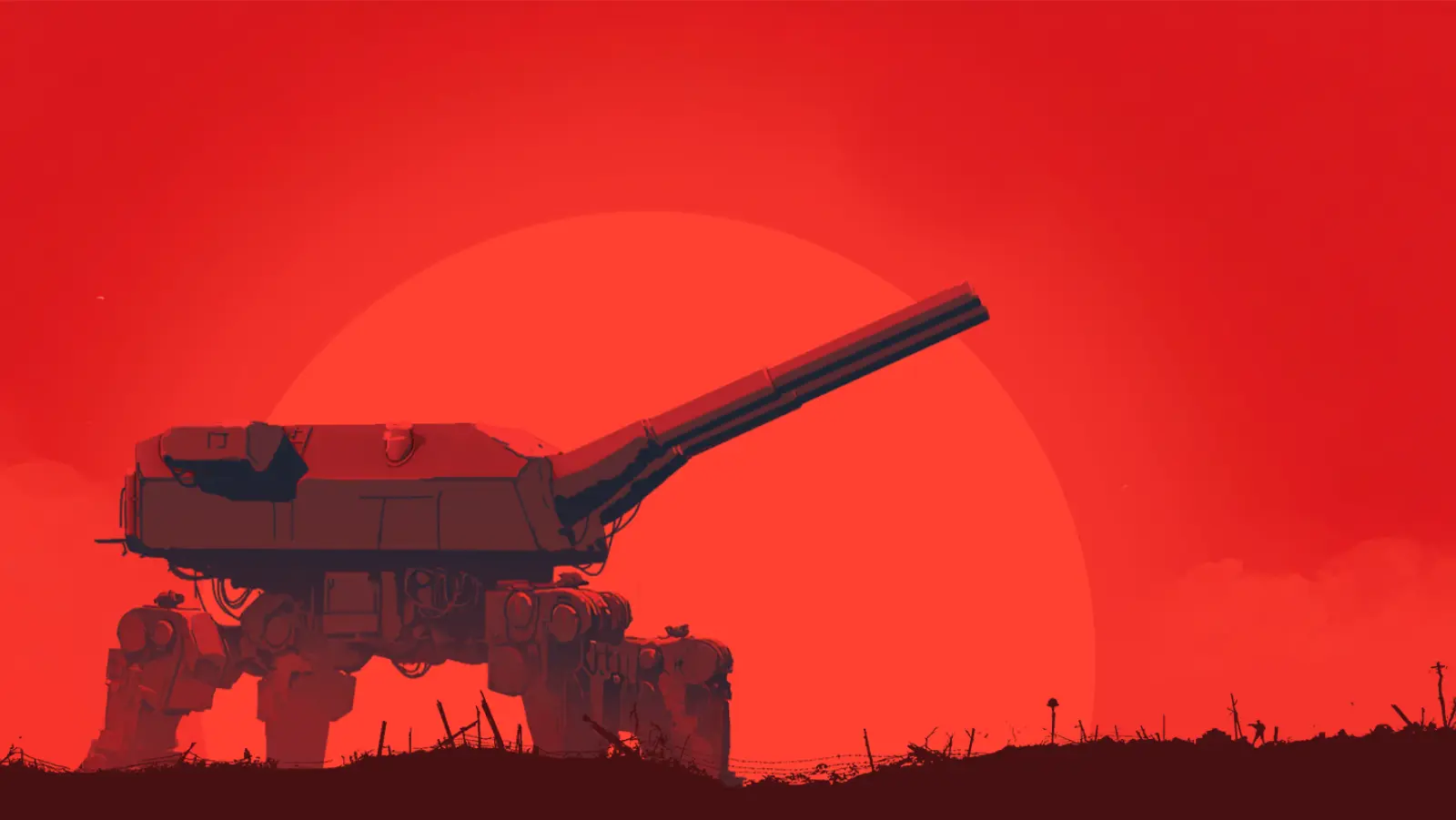
IRON NEST is a dieselpunk war simulator where you take control of a colossal war machine and dominate the battlefield. Instead of a traditional FPS approach, every shot, lever, and dial is in your hands, while High Command issues orders that you decide how to execute.
Behind the project is a small independent team of just two developers: Nick Talmers from Spain and Dominik Latos from Poland. Together they bring more than 25 years of experience in the games industry, and they're developing and publishing the entire project independently, without a publisher or outside investors.
In the interview below, we talk with the developers behind IRON NEST about what it really takes to build and market an indie game, and how they managed to attract more than 200,000 wishlists during the Steam Next Fest.
The interview was taken before the Steam Next Fest.
1. Can you introduce yourselves and explain what IRON NEST is about?
IRON NEST is a brutal dieselpunk heavy-artillery simulator where you dominate the battlefield through a colossal war machine. Every lever, every dial, and every shot is under your control. High Command may send its orders, but the chain of command ends at your fingertips.
IRON NEST is a two-man operation run by its co-founders WITH 25+ years of industry experience: Nick Talmers, stationed in Spain, and Dominik Latos, stationed in Poland. The project is fully self-published. No publisher, no outside investors, and no third parties pulling the strings.
2. Where did the idea for the game originally come from?
The idea first started over ten years ago, watching the cannon fodder anime from the Memories movie. That was like the first kind of culmination of the concept of there being this kind of dystopic universe that revolved around big guns. From childhood I've been obsessed with battleships, artillery, large caliber guns, ballistics, and mechanical systems but cannon fodder is what really kind of brought it together into an experience I wanted to create. Then PVKK kind of proved to me that this is not something that only I'm interested in. That is really the spark that got me thinking more seriously about making this kind of artillery experience that I wanted into a game.
3. Why did you choose the “heavy turret simulator” concept instead of making a more traditional shooter?
I’ve always played action packed tank simulators, and I’ve put thousands of hours into them, but I wanted to create something that felt slower, heavier, and more tactical. What really interested me was the immersion of operating a massive battleship turret, the mechanical animations, the manual controls, the tactile interaction with buttons, levers, and wheels. That kind of diegetic, hands-on gameplay has always fascinated me as both a player and a developer.
4. How big is your development team, and what does each person work on?
Short Answer: 1 Person, I am the sole developer, I do everything from concepting, 3d modeling, animation, game design, programming, balancing, writing, 2d illustrations, etc…
Real answer: 20,801 people. I do not make this game alone; everything I do, I share on the development discord and get feedback, ideas, bug reports, and suggestions from the entire community. In reality, the players are also developers.
5. What has been the hardest part of developing the game so far?
The hardest part has definitely been the mission system. I wanted missions to feel handcrafted and narrative-driven, but also highly replayable, with enemy and allied units never being in the exact same positions twice.
Finding that balance has been a huge technical and design challenge because the missions need to feel logical and immersive, not random, while still staying fun even after replaying them multiple times. A lot of the development has gone into making sure players have enough information to solve situations tactically without the experience becoming predictable.
6. The game already has thousands of wishlists before release. When did you first realise people were genuinely interested in it?
When we first started publishing shorts on TikTok and Instagram, the footage came from a very early build and showed elements that were still clearly work in progress.
However, we began to realize that the project had much broader appeal than we had initially expected. We genuinely believed we were creating a very niche game for a very specific audience - people like us. What surprised us was that the project could resonate with such a wide range of players. Maybe not fully mainstream, but certainly far more accessible and appealing than we had originally imagined.
7. You’ve been promoting the game with almost no marketing budget. How did you manage to grow an audience organically?
Because we do not have a traditional marketing budget, our goal from the very beginning was to appear organically in as many places as possible. The first thing we did was establish a broad social media presence, from Western platforms such as TikTok, Facebook, and X, to more regional channels like BiliBili and Yandex Zen.
Cross-promotion became one of the first major drivers of our growth. Once we saw that our content was starting to perform well, the different platforms began feeding into one another, creating a snowball effect. From there, it became a combination of many different marketing efforts, not only from us, but also from our community.
That is something worth mentioning again: the community has become the third developer of IRON NEST. Without them, we would not have achieved what we have achieved so far.
8. Which social media platform helped the game the most, and why do you think it worked there?
The first platform that really started to bring us noticeable results was TikTok. After that came Instagram, then YouTube, then Facebook, and so on. Over time, we managed to publish viral content across an increasingly wide range of platforms.
However, even if one specific platform was the first major source of traffic at the beginning, in the long term it was the multiplatform approach that proved to be the most important.
One platform may perform better for a while, then slow down, while another one picks up momentum and takes the lead. We still see this today, in one month, one platform performs especially well, and in another month, a different one does.
9. A lot of your videos have a very strong military and propaganda-inspired style. How did you come up with that identity for the project?
The vibe initially came from the original inspiration: cannon fodder and also the Death Corps of Creed from Warhammer 40k. That was always the theme of this dystopic artillery-driven society.
Combined with our gameplay, this allowed players to very quickly understand what they were actually looking at in the video. We came to the conclusion that, since no one knew our game yet, we needed to give them an emotion or association they were already familiar with.
That is where the music came in, heavy military sounds, marches inspired by the First and Second World War era. We thought that if we showed a massive gun, heavy ammunition, and the machinery of IRON NEST, while pairing it with music that people immediately associate with a specific historical atmosphere, it would not take them long to understand the tone and idea behind the game. And it worked.
10. What type of content performs best for you online: gameplay clips, atmosphere, memes, or something else?
It depends on the period. At the very beginning, I would definitely point to our short-form content as the main source of traffic. We also saw strong results from horizontal videos on YouTube, longer-form content, written posts on Reddit, and 2D assets published on X. So once again, it comes back to the importance of being present across multiple platforms.
In the end, it really depends on the quality of the material. Different types of content can perform well in different places. But if I had to identify the core of our marketing efforts, it would definitely be vertical shorts.
11. Did the community and Discord players influence the game’s development in any way?
Absolutely. The community has influenced the game in countless ways throughout development. I develop 100% in the open on our development discord server, so players are constantly discussing new mechanics, providing feedback on my ideas, sharing references, and giving playtest feedback on everything from small UI changes to major gameplay systems.
I’ve spent thousands of hours watching playtests and screen shares, studying how players naturally react, learn, and solve problems. A huge part of the design process has been iterative, making changes, gathering feedback, refining systems, and then repeating that process again and again. Even when a change is divisive, those discussions are incredibly valuable because they help me understand what players are connecting with and what may have been lost in the process.
12. What are your goals for the demo and upcoming playtests?
During the upcoming Steam Next Fest, which begins on June 15, with our demo launching at 10:00 AM PDT, one of our biggest hopes is to appear among the top-performing games of the festival. We would also love to fight for the highest position possible during the festival.
At the same time, we know that many fantastic games are taking part in this June edition of Steam Next Fest, so the competition will be extremely strong. Reaching the top would be a real honor for IRON NEST.
As for upcoming playtests, they are actually already happening continuously on our Discord. Our internal playtests are ongoing and will continue all the way until release, so we invite everyone to join our Discord and sign up.
13. Looking ahead to the release, what do you hope players will remember most about IRON NEST after playing it?
More than anything, I hope players remember the immersion, that feeling of truly being inside this massive battleship turret mech, surrounded by levers, buttons, dials, and machinery while the battlefield erupts around them.
The entire game was built around creating that fantasy of operating something huge, mechanical, and powerful in a very tactile, grounded way. I want players to feel the tension of triangulating targets, loading shells, firing these enormous guns, and slowly mastering the machine around them. That sense of immersion and presence is why I started making IRON NEST in the first place, and I hope it’s something that transports players into my autistic fever dream.








-hero.webp)