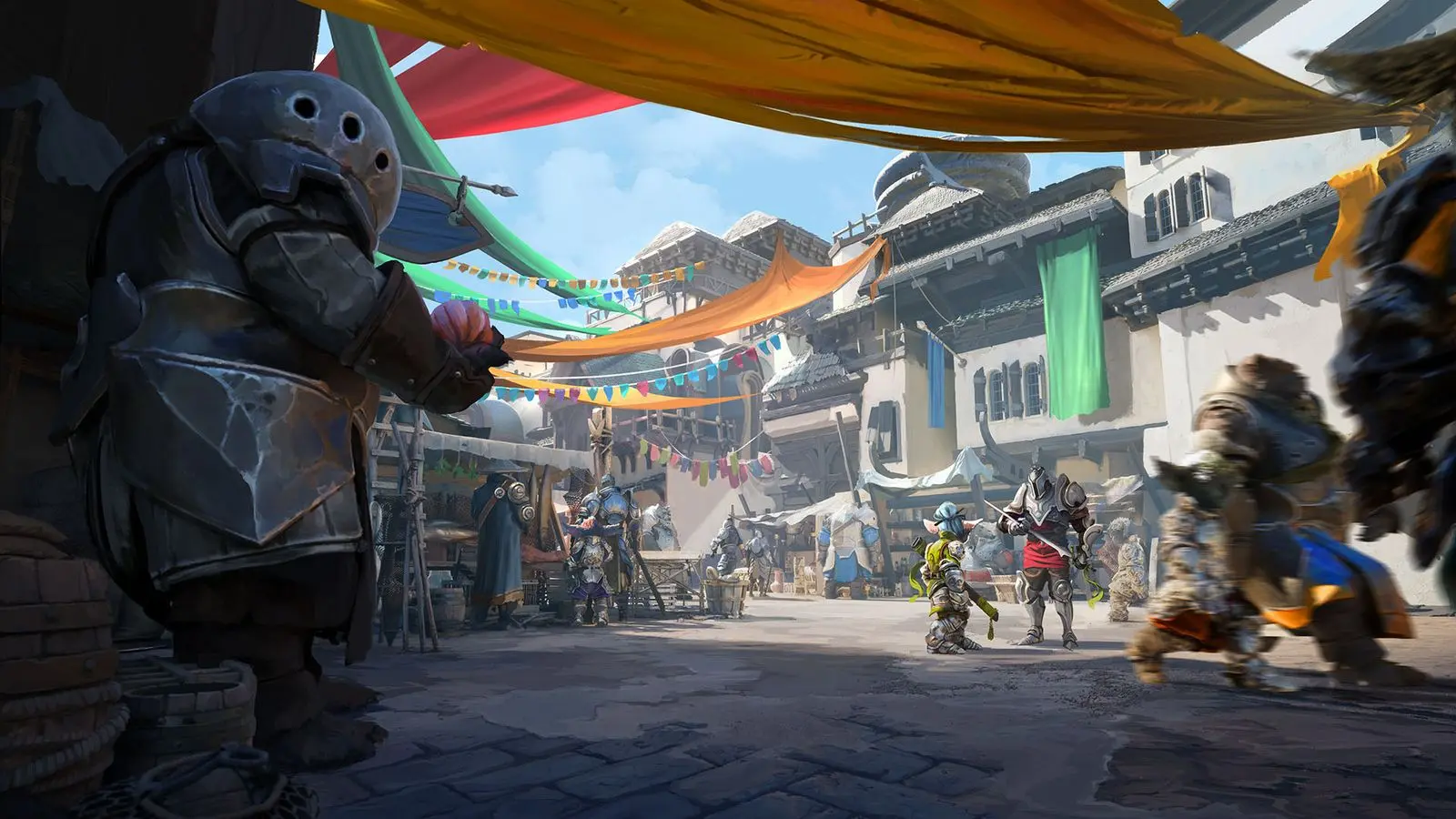
The question that ArenaNet poses in their new post about the development philosophy of Guild Wars 3 is clear: the sequel will not just be a bigger, prettier, or technically more modern version of the previous games.
The first pillar of the answer is the business model. Guild Wars 3 will be a buy-to-play game, meaning that the game will be purchased once, without a mandatory monthly subscription. This has been the case with all Guild Wars releases so far, so this information is not overly surprising. The new aspect is that ArenaNet is taking it a step further by emphasizing that they do not want hidden forms of subscription through paid battle pass systems or similar seasonal models that require constant financial injections from players.
So, this is the second pillar of the answer or philosophy. No pay-to-win, cosmetics only. This does not surprise old veterans of the GW series. Practically, Guild Wars repeats its old mantra. Pay for the game, play, and buy expansions and other shiny items from our item shop.
Thus, the studio maintains that money can be used to purchase cosmetic items, account services, and practical benefits, but not an unfair advantage over players who invest time instead of money. This is especially important in today’s market, where the line between “practicality” and actual advantage is often deliberately blurred.
The third important theme is respect for players' time. ArenaNet recognizes that modern players have more choices than ever before and less tolerance for games that feel like a second job. Guild Wars 3 therefore does not want to build an experience around endless preparation, repetitive grinding, and the feeling that you must play every day to avoid falling behind. The goal is for even a short session to make sense, whether a player has thirty minutes, a few hours a week, or is returning after a long break.
It is particularly interesting that existing players of Guild Wars 2 will be connected to the new sequel through a new Hall of Monuments. With this, ArenaNet wants to acknowledge the long-term investment of the community and transfer part of that legacy into the new game. This does not mean that Guild Wars 3 will simply be an extension of the second game, but rather that the studio wants to respect the history of the franchise while simultaneously building something new. We experienced something similar through Guild Wars 1. However, those were negligible cosmetic items that ultimately did not bring anything significant to anyone. Personally, I quickly forgot that those items even existed. I assume it will be the same here.
The most ambitious part of the announcement relates to the very definition of MMORPG. ArenaNet claims that Guild Wars 3 will not simply copy either the original Guild Wars or Guild Wars 2. The first game was more of a cooperative online RPG with instanced content and smaller teams, while Guild Wars 2 became known for large open maps, world bosses, meta-events, and massive PvP (which did not exactly shine). Guild Wars 3 is expected to fit somewhere between these two polarities.
Which suggests that ArenaNet is not trying to directly replace Guild Wars 2. Instead, the studio wants all three games to exist as different experiences within the world of Tyria. Such an approach may be smart: old players do not receive the message that their game has been abandoned, while the new installment gets space for its own identity. Of course, this is not new since many Guild Wars players still know how to hang out in the old hubs and complete a mission or level up a new character. Especially now that the new release of Guild Wars Reforged and its mobile version have come out.
In a broader sense, Guild Wars 3 is positioned as a response to fatigue from modern live-service games. Many titles today use psychological pressure, daily tasks, seasonal passes, and artificial FOMO to keep players engaged. ArenaNet at least declaratively goes in the opposite direction: less obligation, less pressure, more freedom.
Of course, for now, a large part of this is still philosophy rather than a concrete gameplay showcase. The studio has not yet detailed the combat system, progression, world structure, economy, or endgame content. Therefore, this announcement should be read as a manifesto of intent, not as conclusive proof that the game will succeed.
However, if ArenaNet truly delivers what it promises, Guild Wars 3 could be an interesting attempt to redefine MMORPGs for a new generation of players. Not through more aggressive monetization, larger maps, or endless grind, but through a simpler question: how to create an online world that is fun for the player without creating the obligation of endless grinding?
For a franchise that has already gone against genre expectations twice, this seems like a completely expected direction. Guild Wars 3 will be an interesting experience to play, and the anticipation for the release of the new game definitely increases with each new announcement. I hope that this release of the infamous title will be as successful as it was for the previous two installments.