Going Medieval – RimWorld in 3D, but finally distinct enough.
From day one, Going Medieval has been labeled with the easiest possible tag: “RimWorld in 3D.” And it's clear why. You have a group of settlers, you manage job priorities, balance food, defense, mood, production, and technology, and in between all that, you try to prevent your colony from collapsing due to hunger, winter, disease, or something even dumber. However, reducing Going Medieval to just “RimWorld with roofs” is a bit too simplistic and somewhat unfair. After many years in early access, version 1.0 is finally out.
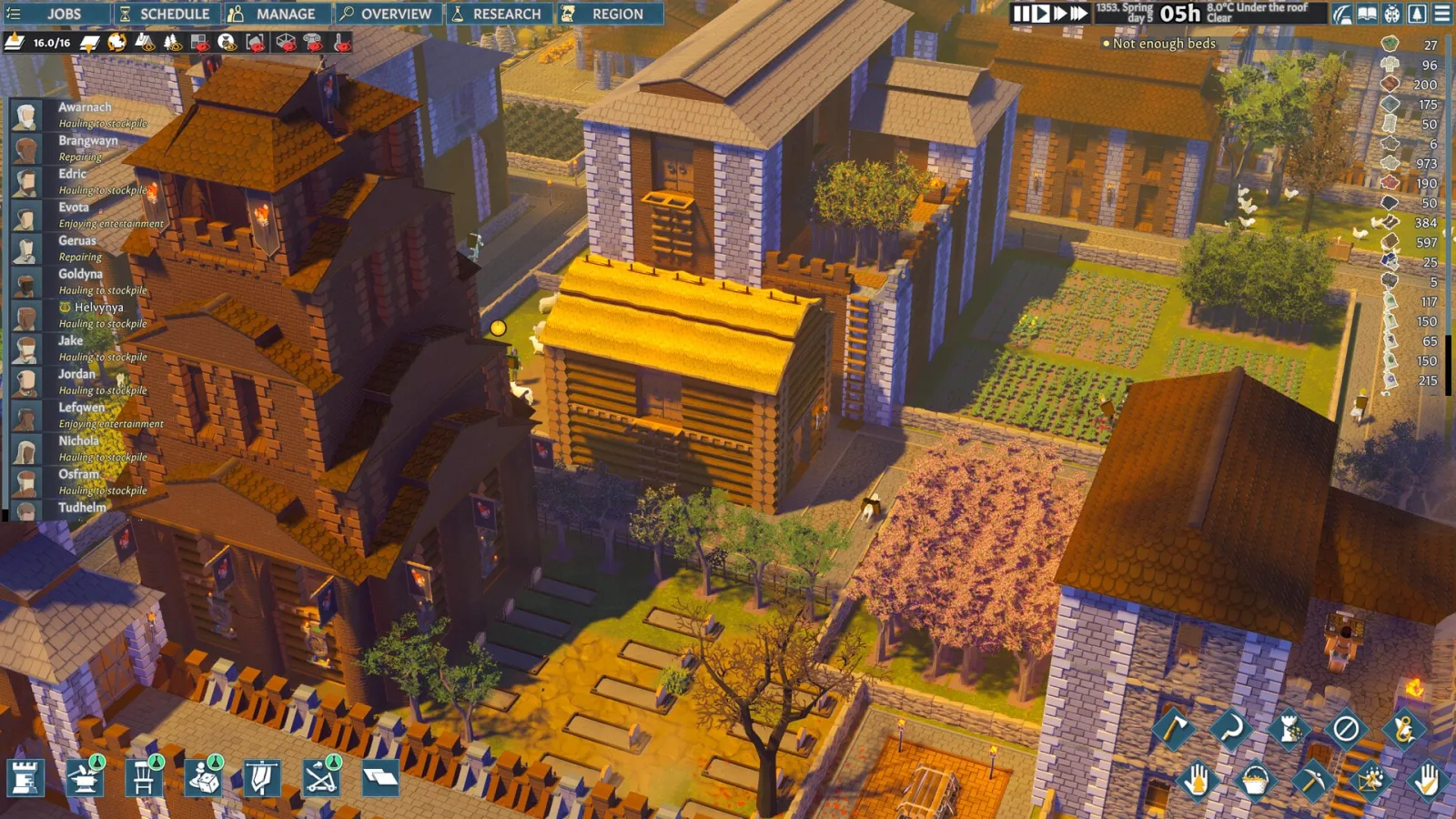
What sets this game apart from most colony sims is not just the medieval flair, but the fact that its third dimension is a real mechanic. In Going Medieval, you don't just build a settlement. You build a cellar that actually cools food, a castle with floors, walls that provide tactical advantages, and underground spaces that can end up as a flooded pit if you relied too much on the ground and luck. The game constantly pushes you to think vertically: where will the storage go, what goes underground, where do the archers have the best angle, how to block access while still allowing people to live normally. This is the difference that makes Going Medieval feel like more than just a reskin of a familiar formula, but rather a game that has taken a well-known formula and decided to literally raise it a floor higher.
You can dig cold cellars for food, raise towers, connect rooms with bridges, arrange roofs, stairs, and defensive points that make sense both visually and mechanically. This is the kind of building that rewards not just optimization but also imagination, so it easily happens that for an hour you don't progress in the classic sense, but just polish the silhouette of your little settlement while enjoying it like a child. Which is, realistically, half the charm of such games.
Of course, building alone wouldn't mean much if the rest of the simulation didn't hold up, and Going Medieval generally stands very well in this regard. Each settler has their own skills, preferences, and flaws, and the game gives you enough control to turn them into a functional community, but not so much that everything becomes sterile and characterless. Managing jobs, schedules, and priorities reminds you of the best in the genre: once you catch the rhythm, you get that nice internal hum of the system where one sows, another carries, a third cooks, a fourth builds, and you just watch as chaos turns into an organized medieval machine. Version 1.0 has further polished the game's introduction through a new tutorial and redesigned starting scenarios, making it significantly easier to enter the system today than before, although it is still not a title that will gently and smilingly explain everything to a complete beginner. This is still a colony sim. Of course, it will first throw you down the stairs, but the feeling of success you get after a little time and effort invested is excellent.
One of the details that makes Going Medieval still feel special is its research system. Here, research is not an abstract bar that fills up somewhere in the background and unlocks new tech. Here, your settlers literally write books, and those books become a resource that you must preserve, store, and defend. Knowledge is a physical thing, as vulnerable as anything else in your colony. If your library burns down or you lose valuable texts, you don't just lose decoration but also part of your progress. This is a great design move because it turns research into something tangible, “medieval,” and logical within the game's world. In a genre that often loves numbers for the sake of numbers, Going Medieval manages to give a dry system an identity.
1.0 is not just a formal exit from Early Access, but also the moment when the game finally received something it had long needed: a true sense of direction. The biggest novelty is the Grand Objectives, final goals related to global statistics such as military, trade, intellectual, or religious reputation. This means that the game is no longer just an endless sandbox, but also has more concrete scenarios: you can turn a town into a pilgrimage center, a pagan sanctum, or a university, depending on how you have developed the settlement. In addition, new roles such as librarian, commander, and broker have arrived, along with new events, new objects, additional types of rooms, new flora, more entertainment buildings, and even 94 achievements.
The atmosphere also deserves praise. Going Medieval opts for a clean, stylized 3D look that is clear, yet charming enough that the settlement does not feel like a pile of blocks. When the snow falls, when the torches are lit, when you see the tower you built dominating the landscape, the game can look truly excellent. More importantly, this aesthetic is not only beautiful but also functional. The clarity of space, layers, and defensive lines is crucial here, and Going Medieval balances the line between beautiful and readable well most of the time.
However, Going Medieval is not a magically flawless medieval answer to all our colony sim prayers. Its biggest problem remains that at times it feels too much like you are managing a system and too little like you are managing people. The user interface can be dense, layered, and somewhat cluttered, especially while you are still learning where everything is. The combat itself can be clumsy, especially when everything starts happening across multiple floors, stairs, and narrow passages. It’s not a disaster, but it’s not a part of the game that you will cherish before going to sleep.
The second problem is that 1.0, despite the whole package of improvements, still does not feel like a “finished point” in the completely smooth sense. After the release, Foxy Voxel continued to roll out patches practically immediately, with fixes for crashes, memory and CPU thread optimization, room planning tweaks, ambush balancing, deconstruction bug fixes, and more known issues they publicly listed, such as pet behavior or the selection of the nearest production buildings. This is not the end of the world, and it is actually commendable that the studio reacts quickly, but it is a sign that Going Medieval entered 1.0 as a very strong product that is still actively being polished, rather than as a perfectly polished final version.
Regardless of everything, the core of this game is incredibly strong. Going Medieval is one of the few colony sims that truly makes me think like an architect, logistician, and local feudal neurotic all at once. It’s not just survival. It’s not just economics. It’s not just defense. It’s a game where space design, settler mood, exploration, seasonality, and defense constantly collide and create small stories. A basement you dug to save food can become a hospital, a prison, a warehouse, and, very easily, the flooded shame of the entire colony. That ability to generate small personal disasters and triumphs from pure systems is why this game stays in your mind even after you turn it off.
Going Medieval 1.0 is a very serious, content-rich, and smart colony sim that today feels more than ever like its own thing. It has taken recognizable foundations, added real verticality, a strong building identity, and enough new goals that the whole adventure finally has a clearer shape. If you love games where you plan walls, shelves, work schedules, basements, libraries, and defenses with the same level of obsession that normal people choose dining chairs, Going Medieval is easily worth your time and it's worth it to "go medieval!"
A copy of the PC version of the game for review purposes was provided by the development studio Foxy Voxel and the publisher Mythwright