Mouse: P.I. For Hire review: A mouse on a secret mission
✅ Prednosti
- Satisfying weapons with good weight feel
- Excellent combination of 2D animations and 3D space
- Fun shooting with a cartoon layer of violence
- Great jazz soundtrack that adds to the atmosphere
- Smooth performance with no significant technical issues
❌ Nedostaci
- Lack of real detective layer
- Repetitive gameplay structure
- Absence of deep investigation and reasoning
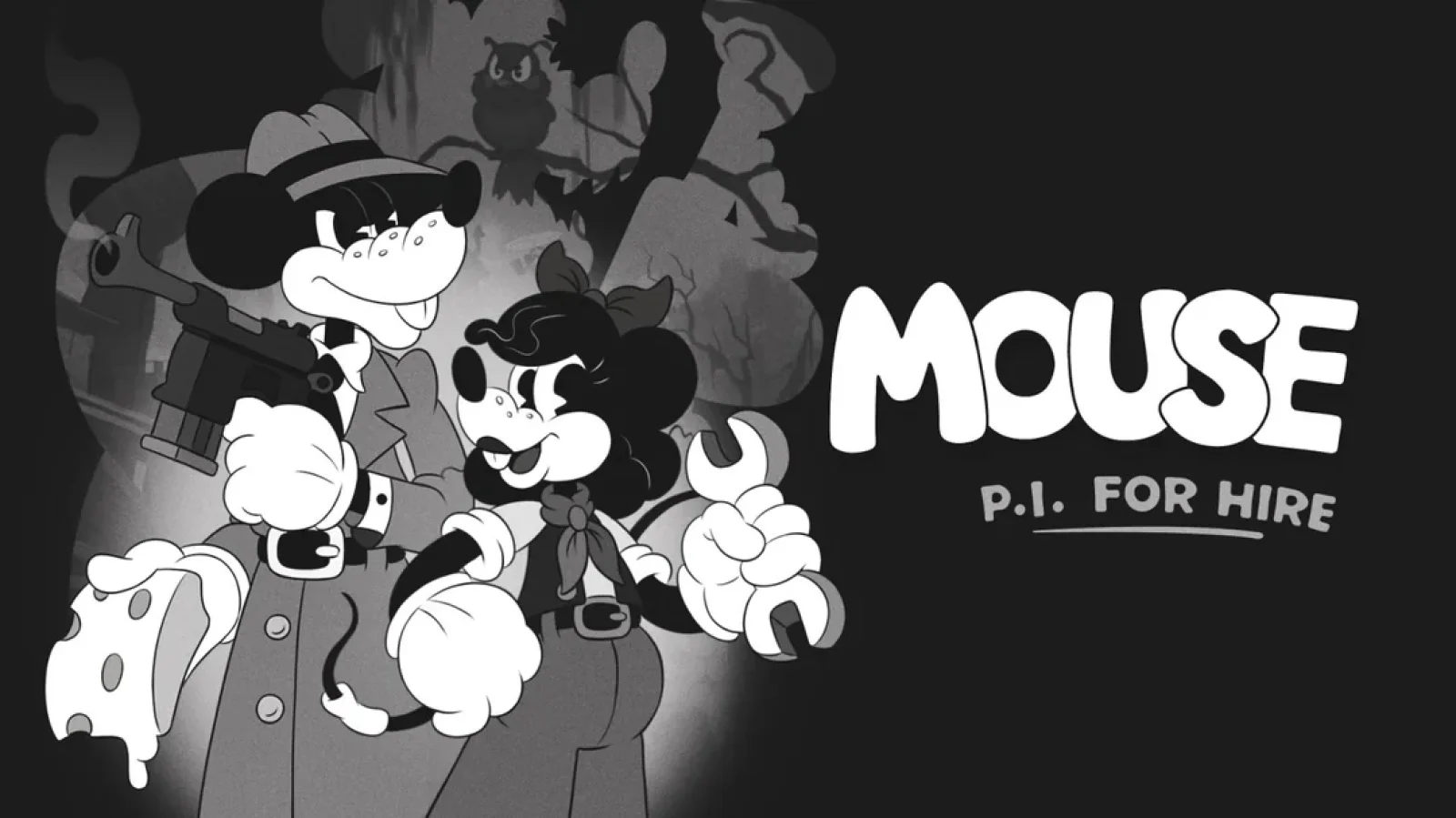
A black-and-white world, rubber hose animation in the style of 1930s cartoons, jazz playing as if someone opened a smoky detective bar, and a mouse private detective who mostly solves problems with a gun: Mouse P.I. for hire reveals what it wants to be in the first five minutes: a noir atmosphere, but with more shotguns than moral dilemmas.
On paper, it describes itself as an action FPS with hand-drawn black-and-white rubber hose visuals, inspired by classic cartoons from the 1930s, along with a noir detective story, big band jazz soundtrack, and an arsenal of cartoon weapons. It sounds like someone threw Cuphead, Doom, and an old detective who smokes too much into a blender. Honestly, the result is much better than that sentence would suggest.
In the game, we take on the role of Jack Pepper, a private investigator in the city of Mouseburg. Jack investigates the disappearance of a famous magician, but he quickly gets embroiled in a much larger mess, full of crime, corruption, gangsters, cultists, and various other symptoms of urban decay, only this time with more mustaches and tails. The story has that classic noir flair: Jack mumbles depressing remarks, the world is dirty beneath its charming surface, and it feels like every NPC will try to kill you at some point.
But what needs to be said right away is that Mouse is not a detective game in the true sense. Yes, you play as a detective, gather clues, there are pictures you put on a board, and cases that Jack connects, but there isn’t much real detective work in terms of deduction, questioning, and thinking for yourself. The game guides you quite clearly: Jack solves mysteries on his board by himself, and you mostly move on, shoot, survive, and clear levels. So if you were expecting a Mickey Mouse version of L.A. Noire, take off your hat and return to reality. This is still a shooter - the detective facade is mostly there for atmosphere, and as a shooter, Mouse functions surprisingly well.
The easiest way to describe it is as Cuphead in a Doom wrapper. The levels are linear, but they are not completely boring corridors. They have that secret areas, hidden resources, and that old-school feeling of exploring space, where the game constantly nudges you forward but leaves you enough reason to peek around the corner. It’s a structure reminiscent of classic boomer shooters from the 90s: go forward, find a passage, clear the space, find something hidden, move on. It’s not revolutionary, but it flows and is well enough structured that the rhythm doesn’t break.
Shooting is fun. That’s the most important thing an FPS must have, and it’s very easy to mess up. The weapons have that satisfying kick, enemies react well enough, and Mouse has that special cartoon layer of violence that makes everything look brutal and funny at the same time. Blasting an enemy with a shotgun, setting them on fire, freezing them, and then smashing them into pieces sounds excessive, but in this visual style, it works perfectly. It’s visceral, but never uncomfortable. More Looney Tunes chaos than horror. Of course, Looney Tunes where someone wears a trench coat and solves mouse corruption with firearms.
Among the weapons, the shotgun stands out in the first few hours, having an excellent sense of weight and impact. There’s also dynamite, which looks great visually but can be a bit imprecise. Particularly interesting are weapons like the portable Freezer, which slows down and freezes enemies, after which you can smash them with other weapons. Its alt fires an ice projectile that explodes on impact and spreads a frost effect on surrounding enemies.
Here is the Devarnisher, a weapon that fires acid and melts opponents over time, while the alternative fire launches a sticky acid mass that explodes after a short delay and deals area damage. James Gun is a fast automatic weapon, ideal for crowds and medium range, which comes in handy when you want to fill the space with lead, while Kiss Kiss leans more towards the explosive side, with rounds that deal splash damage and ignite opponents.
The game uses a blueprint system through which weapons can be upgraded across three levels. The first one typically unlocks the alternative fire, while later levels increase damage, magazine capacity, reduce recoil, or add special effects.
A nice addition to everything are the power-ups like spinach, an obvious Popeye reference, after which Jack switches to fists and literally beats opponents to death. This might be the clearest example of how Mouse combines gameplay and animation logic: the mechanic is useful, but it's also a joke.
The enemies are, as expected, mostly mice. Gangster mice, bigger mice, smaller mice, police mice, robot mice, cultist mice... Quite a lot of mice, all in all. The game uses them sufficiently diversely so that the fights don't become boring right away. It's not chaos on the level of the best modern boomer shooters, but it has enough energy and charm to keep you going.
What really makes Mouse stand out is the presentation. The visual style is absolutely the heart of the game. Characters and enemies look like 2D hand-drawn animations set in a black-and-white 3D world. That blend works surprisingly well. From certain angles, you can see the trick: the characters are actually 2D representations within a 3D space, but as they move, shoot, jump, and break apart under bullets, everything feels very convincing. Fumi Games used Unity for development, and the game itself combines 3D environments with hand-drawn animations in the old rubber hose style. It's not just a passing gimmick, but the identity of the game.
The soundtrack also carries a huge part of the atmosphere. Jazz and big band music give the game rhythm and character, and the voice acting of the one and only Troy Baker nicely hits that line between serious noir detective and consciously exaggerated cartoon performance. Jack's deeply profound depressive remarks fit particularly well because the game doesn't take itself too seriously. It has a noir atmosphere, but it's still a game about a mouse who eats spinach and punches criminals.
Technically, my experience on PC was very good. The game runs smoothly at 60 FPS, without significant issues, stuttering, or crashes. It also doesn't seem overly demanding, which is always nice to see in a time when some games require a graphics card as if rendering an alternate reality, rather than a corridor with three enemies. Mouse looks unique, runs neatly, and doesn't strain the hardware unnecessarily. Terrifyingly reasonable.
The biggest complaint so far is precisely that lack of a real detective layer. Mouse is sold through the idea of a private investigator, clues, mysteries, and a noir story, but in practice, it's quite streamlined. It's not necessarily a problem, as the game clearly knows that its primary focus is action, but it's a shame that the player doesn't have a bit more space to really connect the evidence, draw conclusions, or feel like they are leading the investigation. Jack is a detective, but we are mostly his hand on the trigger.
The second potential complaint is the issue of repetitiveness. So far, the game is saved by new weapons, power-ups, and changes in enemies, but the basic structure is clear: level, shooting, trail, new room, more shooting. If the style doesn't grab you, it's hard to believe that the mechanics alone will keep you engaged for long.
Mouse: P.I. For Hire is a pleasant surprise. It’s not a deep detective game, nor does it try to redefine the FPS genre. But as a stylized, black-and-white cartoon boomer shooter with a noir atmosphere, good shooting, excellent animations, a great soundtrack, and a ton of charm, it does what it needs to do. It has identity, rhythm, and a shotgun. Sometimes that’s quite enough.
If you love FPS games, old-school level design, and visually bold indie projects, Mouse is definitely worth checking out. It’s not overly retro, not painfully archaic, and doesn’t rely solely on nostalgia. Beneath the black-and-white rubber hose charm lies a quite concrete, fun shooter. The mouse is on a secret mission. And the mission seems to have been to create one of the most visually memorable FPS games of the year.
The PC copy of the game for review was provided by the publisher PlaySide Studios.