Nioh 3 – "The Third is Remembered"
The Nioh series has held a special place within the soulslike genre for almost a decade. While FromSoftware defined the foundation of slower, methodical combat, Team Ninja has built its own identity — faster, technically demanding, and strongly focused on deep build systems and mechanics. The third installment comes as a culmination of this approach: it doesn’t try to change the formula but rather to expand and refine it.
Although I have quite a bit of experience with soulslike games, I had only superficially encountered Nioh before, so Nioh 3 serves as a sort of entry point for me, having almost no knowledge of the events from the previous two titles. After completing the first fully realized world and about a quarter of the campaign, the impression is very clear — this is the most accessible, yet polished version of the series so far, where my previous unfamiliarity with the story has minimally affected the overall experience. And no, not because the story is that good. But because the game functions excellently even without paying excessive attention to it.
Developer: Team Ninja
Publisher: Koei Tecmo
Platforms: PC, Xbox Series X/S, PlayStation 5
Release Date: February 6, 2026.
Platform on which the game was tested: PlayStation 5
Starting Price: 79.99 euros
Premise and Narrative Framework
The story combines historical Japan with supernatural elements of folklore. At its core is a broader conflict where political intrigues and wars intertwine with the emergence of supernatural and (mostly) monstrous, bloodthirsty yokai beings, and the protagonist gradually becomes entangled in an increasingly complex web of events, caught between human and yokai claims to power. There will also be time travel and similar narrative twists, within which many will pay with their lives - especially since your weapon does not discriminate when it comes to cutting down a perceived threat - whether it is of human or yokai nature. The character is shaped by you through the initial character builder, where you truly have the freedom to spend an endless amount of time customizing a vast number of physical traits (except for those of an X-rated nature:) The created character then appears neatly and faithfully in all cutscenes, where it is said that although it is not completely mute - in 25 hours of gameplay, I think it has spoken 4-5 sentences - for most of the game, it is reduced to the role of an extremely quiet introverted observer who prefers to communicate with the environment through bloody swings of the chosen weapon. I wouldn't say this is necessarily a bad solution - it is certainly not unseen - but it somewhat kills the immersion when you only watch endless characters delivering their monologues in front of you, while you silently observe them like a deaf-mute intellectual or a pensive calf - I leave it to you to interpret according to your own affinities.
As for the cutscenes, there are quite a few for this genre of game, and they are made on a solid in-game engine, introducing numerous, though (at least for first-time players?) not always memorable and striking characters. To be fair, the characters are accompanied by quite extensive textual descriptions through additional menus, and there was certainly effort put into the creation of cutscenes - so it cannot be said that the story is a mere appendage to the game. However, although the story itself provides a good context and motivation, especially if you are a fan of traditional Japan - I would say that the gameplay is still the main carrier of the experience.
Evolution of the formula — open world with a mission backbone
Nioh 3 transitions to an open-world structure with a free-roam character. The areas are large and designed as spaces for exploration and "map clearing," which can sometimes feel a bit generic, but thanks to the dynamics of combat - it rarely becomes tedious. So you never know which interesting side boss or Crucible challenge with multiple enemies might be around the corner, not so far in the best Elden Ring manner.
And the bosses/enemies aside - exploration also has a concrete function: Kodama increase the number of available elixirs and provide passive bonuses, Jizo statues offer permanent buffs, while flying Chijikoi unlock additional rewards and challenges - just to name a few of the main collectible creatures and items we will encounter. The more you explore, the game eventually reveals more elements of the researched area, with approximate location markers and familiarity with the area. However, it remains up to the player to figure out how to reach something specific or where it is located despite the approximate location, which is not always clear at first. All of this, depending on the mood and affinity for exploration, can provide a quite pleasant dose of thinking and problem-solving, rewarding curiosity and resulting in better items and abilities that you will be grateful for when you encounter a tougher boss.
Along with free exploration, the classic mission structure is retained. Missions can be selected from the menu and replayed in modified versions with new enemies and conditions, which further extends the lifespan of the game.
Combat — technical precision and spectacle
The combat system remains the greatest strength of the game. It is deep, fast, and extremely fluid, and the ability to instantly switch between two builds introduces an additional tactical layer.
It is very interesting that by simply pressing the R2 controller button you switch between Samurai and Ninja builds - which not only have different weapons, which is often the solution within games of this genre. In fact, with that button press, you also gain the ability to have a COMPLETELY different build - with entirely different armors, amulets, and everything that goes with it. It's practically like creating a Strength and Dexterity build in a typical soulslike game, with completely different gear and weapons. And then having the ability to literally instantaneously switch between one build and the other within the fight at the press of a button, or synergistically combine them - depending on how you assess what is most appropriate for any enemy or boss - depending on their speed and constitution. Whether you prefer slower, measured strikes with a wide range of heavier weapons, or a plethora of weaker but extremely fast and fluid strikes.
Add to that even 7 Samurai or 8 Ninja different larger skill trees for each specific type of weapon - which further comes with customization with a range of sub-variants - along with the standard Samurai and Ninja skill trees - you have a wealth of options to make each playthrough at least somewhat special, a unique experience.
Whatever combination you choose, the selection of this author lies in the synergy of both builds (currently Odachi great sword and quick-fire Claws) with fast exchanges - in the best moments, the fight takes on an almost stylized, spectacular character: deflect strikes Samurai style, charge Guardian Spirit Skill with attacks and deliver a stronger mid-combo, anticipate the red unblockable attack with a timely strike to break the enemy's guard - and follow up with a switch to the Ninja build, where you quickly dodge behind the enemy with a broken guard and deliver a barrage of backstab strikes with increased damage - to mention just one of a series of possible scenarios. Once the system is mastered - which I would say takes a newcomer to the game within the first 5-10+ hours, it increasingly resembles a combat dance rather than classic soulslike mind games. The game often gives a feeling of complete control and power, which is a rarity even within the genre.
Boss fights can initially take several hours until the mechanics click, but for players familiar with the rhythm of the genre, that process goes noticeably faster. Once the tempo is mastered, the combat becomes extremely satisfying.
Who are the usual culprits? Variety of enemies and artificial intelligence
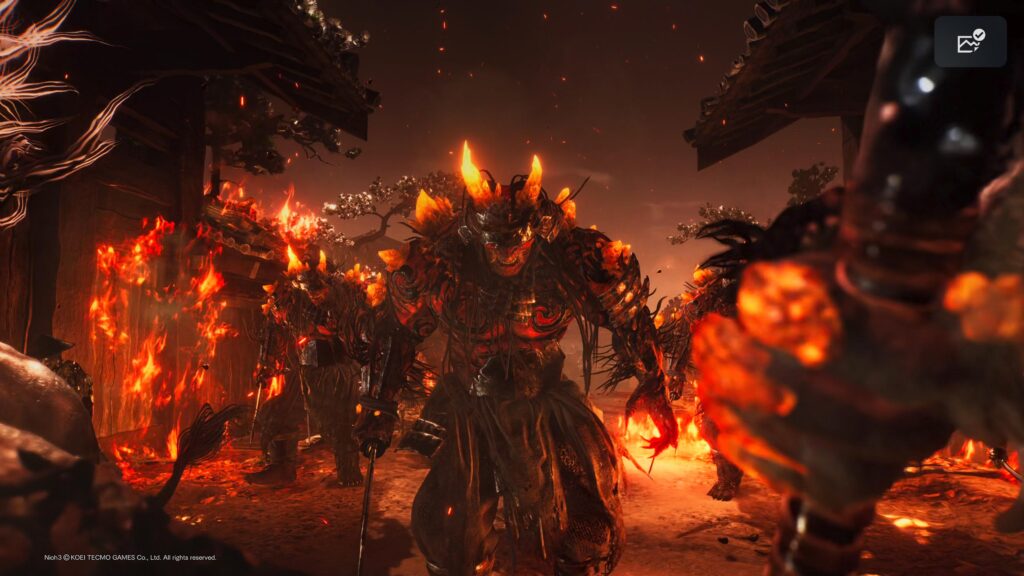
Some good-natured guys.
Nioh 3 offers a very wide range of so-called mobs that will try to stand in the way between you and achieving your goal - from human opponents and soldiers of various fighting styles to numerous yokai beings with completely different attack patterns. This diversity ensures that encounters rarely feel monotonous, as each type of enemy requires a different approach — from patiently reading attacks to aggressive pressure or precise management of Ki resources.
The artificial intelligence in open combat works quite solidly. Enemies know how to punish excessive aggression, use their abilities at the right moments, and often create a sense of tactical competition, especially in larger groups or elite encounters. An additional layer of challenge is brought by the so-called Master opponents who appear in certain regions as a kind of mini-boss encounters. They have more complex movesets and greater endurance, serving as a test of the player's current readiness and effectively breaking the rhythm of standard fights.
Along with them, the game occasionally offers Crucible fights — closed arenas where the player faces waves of enemies or particularly challenging encounters under specific conditions. These sequences function as pure gameplay challenges, often focused on endurance, space control, and build optimization, providing a welcome change of pace and an opportunity to check progress outside the classic mission structure.
Stealth segments represent an interesting contrast. Enemies sometimes react slower or do not notice eliminations and the screams of the unfortunate who come within a meter or two, which can seem unrealistic and break immersion. On the other hand, such an approach can also be seen as a design decision that gives the player space to breathe and plan encounters more easily - not unlike what we have seen in genre giants like Sekiro. Depending on expectations — whether someone is looking for a realistic simulation or gameplay that occasionally "gives way" — this element can act as both a flaw and an advantage.
Ultimately, the variety of opponents, additional challenges like Master encounters and Crucible arenas, and sufficiently competent AI make combat dynamic and unpredictable, further emphasizing one of the game's greatest strengths.
Mobility and the feeling of control
Character movement in Nioh 3 feels fast, precise, and very responsive, which is crucial for a game that relies so much on timing and positioning. Basic actions like sprinting, dodging, and quick direction changes are executed fluidly, so the character always feels under complete control, even in more chaotic battles.
The game also brings greater verticality compared to previous installments, with the ability to jump, climb certain structures, and move faster through more open areas. This not only facilitates exploration but also adds a tactical dimension to battles, as positioning and space control become even more important.
Animations are smooth and clearly linked to input, so movement never feels sluggish or imprecise. This combination of agility and readability gives movement a sense of "weight without sluggishness," further enhancing the overall feeling of control over the character and making each fight more dynamic.
Customization and loot — freedom at a cost
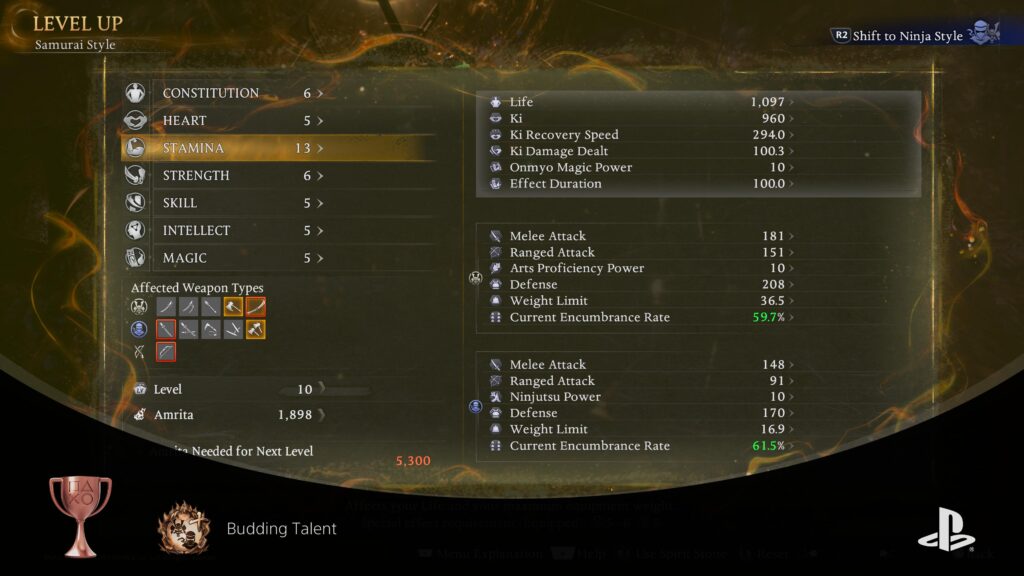
Typically atypical Level Up Attribute menu. Pro Tip - Stamina is NOT what Stamina is in other games. Here it is Ki. And for that, look more towards the primarily Heart, and secondarily Intellect sections.
The depth of customization is one of the hallmarks of the series. Weapons, armor sets, skills, and modifiers allow for the creation of completely different builds, and from the very beginning, there is a very rich character builder that enables great aesthetic diversity.
On the other hand, the amount of loot can be described as "overwhelming" at the very least. The game features thousands of items - by the end of the first chapter, I had over 1200 out of 2000 items, collected solely through exploration without a single purchase - and it's not always easy to assess what is truly worth keeping.
The rarity classification system using colors and the option for automatic "offering" of weaker equipment helps, but occasionally managing the inventory does slow down the pace and becomes somewhat mentally exhausting - whether you're converting it into materials for crafting stronger weapons, armor, and other items.
Attribute System and Character Development
Character development in Nioh 3 is based on clearly defined attributes that directly shape the playstyle and combat pace. Constitution increases maximum HP and overall stamina, while Heart affects the amount of Ki and the effectiveness of ranged combat. Stamina determines the maximum equip load and resistance, allowing for the wearing of heavier armor without losing mobility. The offensive dimension is further shaped by Strength, which increases Ki damage and the effectiveness of heavier strikes, and Skill, which improves the performance of combat techniques and Ninjutsu abilities. On the other hand, Intellect speeds up Ki recovery and extends the duration of magical effects, while Magic directly increases spell power. The combination of these statistics allows for a wide range of builds — from durable warriors and hybrid styles to agile or magic-oriented characters — and the way points are allocated has a significant impact on the rhythm and approach to each fight.
Ki can be said to be what stamina represents in other games - that is, the resource needed for any attacks, dodges, etc. - which, if depleted, forces the player to wait for it to refill, leaving them vulnerable to potential attacks during that time. That said, for players coming from other soulslike games, the direct Stamina attribute is somewhat misleading in Nioh 3, called Heart. While under Stamina lies the attribute responsible for the weight you can carry before you fall into the slower movement class - which in other games is usually covered by the Endurance label. So keep that in mind before you pump about 10 levels into Stamina and then wonder why your character still gets winded after 2 hits, but at least it seems there’s no issue with carrying heavier equipment :)
Mobility and Sense of Control
Character movement in Nioh 3 feels fast, precise, and very responsive, which is crucial for a game that relies so heavily on timing and positioning. Basic actions like sprinting, jumping, dodging, and quick direction changes are executed fluidly, so the character always feels under complete control, even in more chaotic battles. Increased verticality, along with jumping and easier terrain navigation, further contributes to the dynamics of exploration and combat.
On the other hand, the movement system has several limitations that can occasionally be bothersome. The character cannot swim, so falling into water or outside the designated boundaries automatically results in being returned to the last checkpoint. This approach is reminiscent of older design philosophies and can be somewhat irritating, especially when it is not always clear whether a certain surface is intended for movement or just a visual part of the environment.
Unlike some games in the genre, such as Sekiro, where falling usually returns the player to a safe surface with a penalty in the form of lost health, Nioh 3 takes a stricter approach. On one hand, this enhances caution and a sense of risk, but on the other, it can create frustration in situations where navigation is less intuitive.
The design of invisible walls is also not perfect — occasionally, there may be boundaries that are not entirely logical from the player's perspective. However, such moments are not frequent (definitely not as frequent as in, for example, Wukong, where I would say they are the main design complaint) and rarely seriously disrupt the pace of gameplay. Overall, mobility is very well executed and supports the fast pace of combat, but occasional limitations remind that the game prioritizes control and balance/(semi)linearity of different areas over complete freedom of movement.
Cat-like Beings and Spirit Guardians — Folkloric Contrast to Brutality
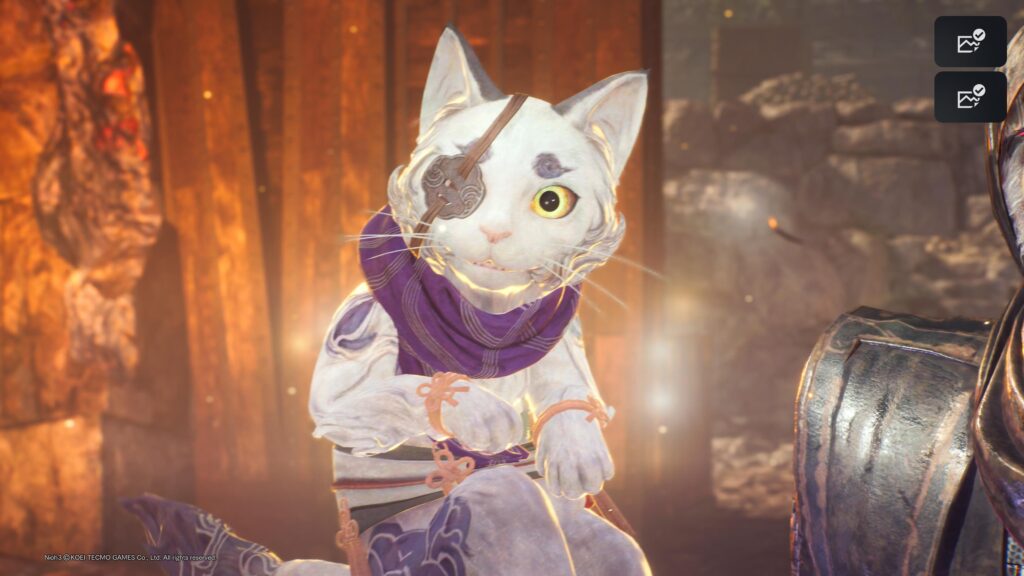
The esteemed Cat in Boots, Japanese style.
Among the numerous serious and often quite brutal elements of the Nioh 3 world, cat-like beings inspired by Japanese folklore stand out, particularly the legends of nekomata and related yokai variations. Their presence brings an interesting tonal contrast — while you spend most of your time in tense and harsh battles, encounters with these creatures inject a dose of warmth and playfulness into an otherwise dark world.
In addition to their aesthetic role, these beings also have a minor gameplay function, whether through small rewards, buffs, or simply as a brief respite between intense skirmishes. It is precisely this rhythmic break from constant tension that makes them a charming addition that will particularly delight cat lovers (albeit specific versions of cats, but as we know, All Cats Are Beautiful).
The folkloric aspect of the game is further emphasized through Spirit Guardians — supernatural beings that act as a sort of spiritual companions for each character. They are not just visual symbols, but also a mechanically important part of the combat system, as they provide passive bonuses, special abilities, and additional options in key moments of battle. Narratively, they function as an extension of the character's identity, while in gameplay, they represent another layer of personalization and tactics.
Together, the feline-like creatures and Spirit Guardians highlight one of the more interesting dimensions of Nioh 3 — the game's ability to balance between brutal action and folkloric mystique. This contrast not only enriches the world but also gives the experience an additional personality that sets it apart from many other titles in the genre.
Music and Sound
The music is composed by the internal composing team of Team Ninja in collaboration with long-time external arrangers who also worked on earlier titles, so the soundtrack retains the recognizable identity of the series. It is based on a blend of orchestral film scores and traditional Japanese instruments like shakuhachi, koto, and taiko drums, emphasizing the historical ambiance with a mystical touch.
During exploration, subtler, ambient compositions dominate, creating a sense of space and light tension, while battles — especially boss encounters — transition into stronger, rhythmically emphasized compositions with pronounced percussion and strings. This very dynamic makes the soundtrack highly functional as it clearly follows the intensity of the gameplay.
The sound design further supports the experience: weapon strikes, skill effects, and the reactions of enraged enemies have clear weight and readability, while many gameplay mechanics are supported by sound cues, especially parry and burst attacks, so the audio component serves not only the atmosphere but also directly underscores the gameplay experience, which is extremely important in such a game.
Visual Style and Performance on PS5 Pro
Nioh 3 uses an enhanced version of the internal Team Ninja engine developed on the foundations of the technology used in Nioh 2 and The Rise of the Ronin, with additional optimizations for the current generation of hardware. And while Ronin as a title in 2024 was occasionally criticized for certain outdated graphics, from not-so-reputable textures and uninspired characters, as well as a graphically underpopulated open world - Nioh 3 seems to have taken a lesson from that and "beefed up" everything at least a bit:
The visual pipeline relies on modern physically based rendering (PBR), dynamic lighting, and advanced post-processing effects such as volumetric fog, motion blur, and real-time reflections. Particle effects and shaders for energy attacks particularly stand out, giving battles a distinct visual dynamism without losing readability.
On PS5 Pro, the game utilizes enhanced resolution profiles and a more stable framerate compared to the base version, with very consistent frame pacing during gameplay. Framerate drops are rare and usually tied to more demanding cutscenes. In open areas, texture pop-in can occasionally be noticed - textures that suddenly change from lower to higher resolution, in a way as if they are being loaded directly in front of the player - which can be somewhat irritating for the discerning eye. However, to be fair, these are minor occurrences that do not affect gameplay and only slightly impact the generally solid visual impression, and it is also difficult to find a high-end open world game on the PS5 hardware, even the Pro version, that is completely free of this phenomenon.
Overall, the technical performance does not aim solely for maximum visual realism but clearly prioritizes responsiveness and performance — which is a logical and successful design choice in the context of a demanding combat system.
Duration and Amount of Content - CooP PvE minus PvP
Even after the first world, it is clear that this is a huge game. I spent a good 20 hours thoroughly cleaning that world, including a number of its sub-areas. I am currently at the beginning of the second world, which seems to be slightly smaller, followed by two more worlds. So, judging by the current projection, the total duration could easily amount to 80-100 hours of gameplay for players who love to explore every nook and cranny, especially those prone to earning trophies. And this is all just speaking for the first playthrough.
For a more focused approach to the campaign, estimates suggest around 30–50 hours for the main story. Of course, the duration of the game will also depend on your ability to handle certain bosses, which can make specific sections noticeably longer if you get stuck. Again, if it’s not beneath your dignity, you also have the option of cooperative play with other players - whether you want help against standard mobs or bosses.
One of the elements that some players might consider a drawback is the absence of a classic PvP mode. As someone who has over 600 hours of PvP experience in Elden Ring - from duels, arenas, to open invader often 1 vs. 3 ganker mind games - I could certainly count myself among that group of players. Given the depth of the Nioh 3 combat system and the variety of builds, competitive clashes on paper seem like a logical addition that could extend the game's lifespan.
Interestingly, the first Nioh had some form of PvP, but that segment never took off in the wider community. Balance issues, differences in builds, and generally the players' focus on PvE content led to PvP remaining a secondary activity with little impact on long-term popularity.
In that context, to be fair, the decision to completely omit PvP in Nioh 3 seems like a conscious design choice. The focus on single-player and cooperative experience allows developers to build systems without the compromises needed for competitive balance, resulting in a cleaner and more coherent gameplay.
They likely also reduced the often quite toxic number of communities that come with direct PvP soulslike experiences, where this author, during the Elden days, received hate messages in the console inbox from bitterly defeated opponents with a sea of excuses and accusations for their fresh loss. So, by omitting PvP, the spirit of player community is nurtured more than discord. Developers even introduced an interesting online gameplay solution, where in the area of a player's death you can find their version with a brief description of the level, weapons, and how they exactly died - after which you can summon their red version to defeat it. It will be controlled by the game's intelligence, and you will receive part of their items. But at least they won't send you hate messages in your inbox after you defeat them.
Difficulty and Accessibility
Nioh 3 remains true to the series' reputation as a demanding action RPG, but the way it approaches the challenge feels significantly more balanced than in previous installments. The game does not lower the difficulty in the classic sense nor do you have a difficulty selection, but makes it more readable and fair, with clearer rules and greater flexibility in combat approach. And if you can't get through something at all, you have the mentioned help from other players through CO-OP.
Having said that I haven't played the first two parts, I asked colleagues who have, and who also played this third part, to give me their opinion. This would be their summarized experience: compared to the first Nioh, which often proved to be extremely ruthless and sometimes punished players with sudden spikes in difficulty, the third part feels more consistent. Encounters are better structured, and enemy attacks are more clearly telegraphed, making defeats less frustrating. Nioh 2 had already taken a step towards better balance, but it still could be very demanding in later stages due to the more aggressive enemy design and complex systems.
Nioh 3 goes a step further and brings perhaps the most natural learning curve in the series. Early bosses for newer players can still take an hour or two or three+ until the mechanics click, but once the player masters the basic principles — resource management, combat tempo, and using builds — progress becomes very tangible. It is this clarity that makes the game more accessible without losing challenge.
Veterans of the series will still find plenty of challenging encounters, especially in later stages and optional content, where thorough knowledge of movesets and build optimization is required. But unlike the first part, where difficulty sometimes felt like a barrier, here it feels like a natural part of the learning process.
Ultimately, judging by my colleagues, Nioh 3 achieves the best balance in the series — it maintains a solid level of challenge but presents it in a way that is more transparent, fairer, and more accessible, making it the most mature iteration of the system so far.
Conclusion
Nioh 3, after just the first twenty hours, leaves the impression of a game that knows exactly what it wants to be — and it achieves this with exceptional confidence. Team Ninja has not tried to radically redefine the series but has upgraded it in almost all key segments: combat is more flexible and spectacular than ever, the world structure offers more freedom, and the character development systems provide immense depth without losing readability (at the cost of some initial confusion).
From the perspective of someone encountering the series more seriously for the first time, perhaps the biggest surprise is how quickly the game manages to "click." Despite its complexity and reputation for difficulty, Nioh 3 communicates its rules very clearly and constantly rewards learning. Every advancement — whether mastering boss mechanics or optimizing builds — feels tangible and motivating, making the experience extremely addictive. In the days following my play sessions, I found myself drawn into the game to the extent that only the low battery warning on my previously fully charged controller reminded me how much time had passed since I started my session.
Of course, there are compromises. Open-world activities can sometimes slip into repetitiveness, and the amount of loot can feel overwhelming and slow down the pace. However, these elements rarely outweigh what Nioh 3 does best — providing a deep, technically precise, and extremely satisfying combat system.
In the broader context of the genre, Nioh 3 feels like the culmination of the series' philosophy and one of the most confident, mature soulslike titles in recent years. As an entry point into the series, it leaves the impression of a game that is both accessible enough for new players and deep enough to retain veterans.
If the rest of the campaign maintains the level of quality seen in the first quarter of the game, it is hard to imagine the final impression being anything other than extremely positive — and it is very likely that Nioh 3 will remain one of the most memorable action RPGs of this year, and possibly beyond.
Rating: 4 / 5
Pros
- exceptionally deep and fluid combat system
- high level of character mobility, both in-game and on the map
- great flexibility in builds and play styles
- huge amount of content and good value for money
- solid technical performance on PlayStation 5 Pro
- striking visual style and strong presentation
- the most polished and accessible version of the formula
- specific cat-like and other charming creatures
Drawbacks
- the loot system can be cluttered and require frequent inventory management
- some open-world activities can feel repetitive
- the lack of swimming, where falling into water results in instant death, somewhat disrupts immersion
- the story is interesting (if you're fans of Japan), but at times generic and not the main motivator; the protagonist is not completely mute, but for the most part is de facto, and does not contribute to immersion
- for those seeking ultimate combat realism supported by top-notch enemy artificial intelligence, it will not be found in stealth segments;
- minor technical imperfections - slight performance drops in cutscenes, texture pop in the open world
A copy of the PlayStation 5 version of the game for review purposes was provided by the publisher Koei Tecmo