After a long period in the early access phase, Timberborn finally arrived in its full 1.0 version, and we can immediately say - the wait was worth it. This city-builder/strategy with unusual protagonists, beavers, brings a refreshing twist to a genre that is often overwhelmed by classic formulas. Timberborn isn't trying to be another clone – he's building his own identity, plank by plank.
The action of the game is set in a post-apocalyptic world where people have disappeared and beavers have taken over the role of the dominant species. But nature is not very tame – droughts are frequent, water is essential, and survival requires careful planning. This is precisely where Timberborn excels.
The player takes control of a colony of beavers and must build a functional settlement that can survive extreme climatic conditions. The beginning is humble – a few beavers, basic resources and a flowing river. But very quickly things become more complex. Build houses, farms, sawmills, warehouses, but also more advanced structures like dams and canals.
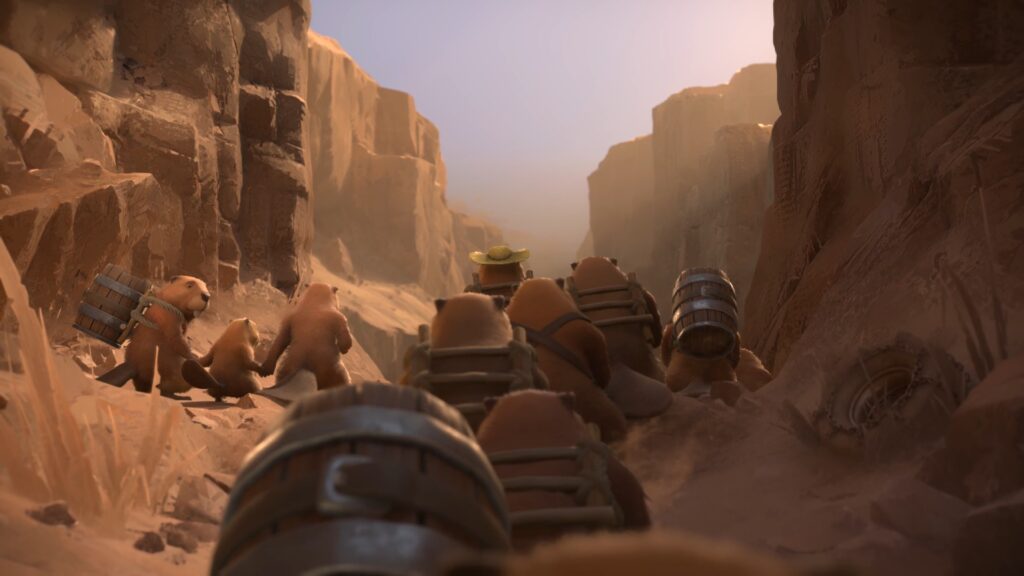
One of the most interesting aspects of the game is water management. Timberborn makes you think long term – it's not enough to have water now, you have to have it during the drought. This means building dams, reservoirs and irrigation systems. The feeling of successfully surviving a long drought thanks to your own engineering is extremely satisfying.
In addition to infrastructure, the game also offers technology development. As you progress, you unlock new buildings and tools that allow you to manage resources more efficiently. Automation becomes crucial in the later stages, and this is where mechanical beavers come in – robots that can work without the need for food and water. Yes, you read that right – beaver robots.
Timberborn također nudi izbor između dvije frakcije, svaka sa svojim stilom igre. Some are focused on industry and efficiency, while others are more focused on ecology and sustainability. This choice adds extra depth and replay value, as each faction requires a different approach.
Visually, the game is charming and clean. The style is somewhat cartoonish, but functional – everything is clear and transparent, which is key for this type of game. The beaver animations are adorable, and watching them work hard adds an extra layer of immersion.
As for version 1.0, it brings a number of improvements and optimizations. The systems have been refined, the balance is better, and the game seems rounded. It feels like the developers listened to the community during the early access phase and implemented useful changes.
Of course, not everything is perfect. In the later stages of the game, saturation can occur, especially if you have already built a stable system that easily survives all challenges. Also, although there is a certain level of challenge, hardcore players may want more complex mechanics.
However, despite these minor complaints, Timberborn 1.0 is an extremely high-quality game that offers hours and hours of fun. Its combination of city-building, survival elements and resource management makes it unique on the market.
Finally – if you are a fan of strategy and looking for something different, Timberborn is definitely worth your attention. Beavers may seem cute, but their struggle for survival is anything but simple.
A copy of the game for review purposes provided by the development studio Mechanistry