Since the very beginnings of the gaming industry, there have been certain markings that indicated the age limit of those for whom the game is intended, despite the homely old-fashioned "Games are for small children". To be honest, hardly any gamer even looks at that black and white label, because the most important thing for everyone is what is on the cover. How to continue to fight against customer carelessness and how to know for whom certain games are suitable, and how advanced this categorization is, find out in the following lines
We all know what organizations like the ESRB are up to, they question who can and who can't play certain games. Of course in more orderly environments, they worry about whether a game is suitable for a certain age or not, but in our country no one respects that, maybe because pirates don't even have a lower age limit for a gamer who can or can't play a certain game. Read the text about such organizations, which may spoil the pleasures of generations.
Be that as it may, this organization will soon have no business with this kind of production, because the number of "mature" games (M) has decreased by as much as 50% since 2005. The number of games available for all ages has increased, now it is as much as 60%, 59% to be exact. Games that can be played by those over the age of ten took about 15%. Those older than 13 can play another 20% of games, and those older than 18 can boast of only 6% of games unavailable to younger generations. This means that violence in games has greatly decreased in the past two years, and yet there is more and more talk about how games influence the increasingly frequent murders, massacres, tortures and suicides in the world. Definitely, the massacres in various shopping centers and even schools in the USA and in Finland did not leave anyone's mind. Such cases have managed to be connected to various multiplayer shooters, from which, allegedly, the perpetrators draw inspiration, but it is questionable how many such cases there would be even without gaming, because there have always been psychopaths, before and much more than today. Such people may have found inspiration in the games they were more or less addicted to, but these games are not the only reason why such people committed a crime. Who knows, if it weren't for games with violent content, maybe reading certain content, or reading certain newspapers, would be prohibited in the same way, because such things can inspire crime. Who knows, maybe someone would ban anime because of their content, maybe because of such laws children would not watch animated legends such as Lucky Luke, Tom & Jerry, and many others. The key reasons for such cases come from early childhood, family abuse, neglect of children and, of course, poor upbringing.
Games are also an educational unit, maybe real events should be described in games, so it might be easier to learn subjects like history. Maybe organizations like the ESRB should care about the truth in certain content, that way maybe some diversity in games could be achieved. Americans would not be positive faces in every game, they would not always save the world by beating partisans, Japanese, Nazis, Russians, terrorists and numerous other "bad guys". But let's go back to the problem that PEGI, ESRB and others are concerned about, i.e. the classification of games according to an age limit. Games like Half-Life are certainly not for the youngest. But how can I put a 16+ on a game like Call of Duty and a 3+ on a game like NFS Prostreet. Did any of them think that some 16-year-old boy, how old is it to get a driver's license in the USA, will get behind the wheel and go crazy on the road, smashing, overtaking and everything else like he did in the game? I think the content of such games is more accessible than a rifle or a pistol. This is absurd, but this absurdity should not be treated by banning both of them to everyone under 60, such things should be solved by education and talking to children about such problems. At school, they tell us about how such and such a battle was in such and such a year, but the information about the dead and captured in such battles is always less important than who won. Professors only briefly tell us everything, list the years and go on, but schools as educational institutions should teach us humanity and problems related to deviant behavior based on historical facts. Maybe then it would be unnecessary to ban games.
Ah, the world is full of absurdities. My godfather tells me that in Germany they have to download games from foreign PS3 stores, the reason being that all such content is prohibited on the German online shop. Therefore, demos of games like Unreal Tournament cannot be found on their offer because of the violence in those games. Well, can someone explain to me where in this case is that company (BPsj - something like the German ESRB) which in its opinion forbids / allows legendary games. Or it was too much for them to put a note on the PS3 online store that they should not be accessed by people younger than so and so many years old without the presence of adults. This is how a 20-year-old can't download a demo of a legendary game because the people who take care of the PS3 store in Germany think that game is not suitable for younger generations. Now we have to ask ourselves until when the ESRB and similar organizations will tell us what is suitable or not for certain generations. And if they want to justify their actions, and at the same time admit that serious crimes were committed because of games, then why does the gaming industry need such organizations. Why do you have to wait longer for a game because people from the ESRB have to assess for which age a game is suitable?!
In order not to confuse you, I must mention that in addition to the ESRB, there are also organizations for Europe, PEGI, and for some European countries special organizations that operate only internationally.
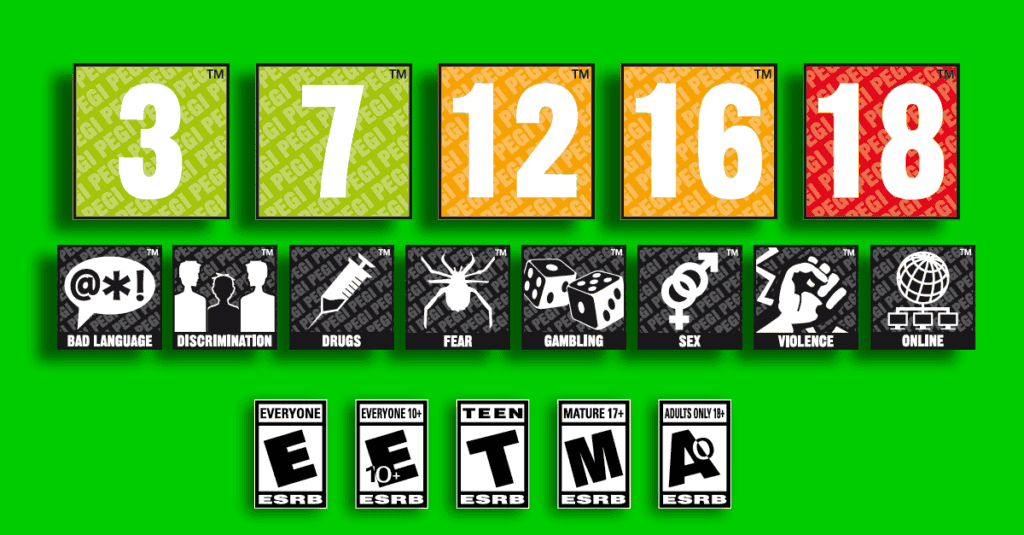
ESRB and PEGI ratings
Early Childhood (early childhood) - this category is equal to the PEGI 3+ category, but see miracles. We have always known that Europeans are a bit smarter and more advanced than Americans, but do children in Europe grow up psychologically faster, so according to PEGI, NFS in Europe falls into the 3+ category, while in America it is in the E10+ category. The ultimate stupidity and illogicality, two organizations with the same goal cannot agree on one game. But to cut it short, this category includes everyone over the age of 3.
Everyone (everyone) - this category is equal to the PEGI 7+ category, and it includes all games that, according to "experts", are suitable for those older than 6 years. This category includes games like Bugs Bunny - Lost in Time, and judge for yourself how much the drawn witches and other freaks that appear in these games affect a six-year-old.
Everyone 10+ (everyone over the age of ten) - closest to the PEGI category 12+, and this category includes games like Donkey Kong Jungle Beat, which from a critical point of view is bad for children entering the socialization process, it's nice for a child to develop imagination, but animals that fight are not the best example of that, I think who would want a pet after that.
Teen - this category includes everyone older than 13 years old, and it cannot be compared with any PEGI category, because the next category according to PEGI is for those older than 16 years old, which makes sense, because a 13-year-old is very different in terms of psychological characteristics from a 16-year-old, and three years is a huge difference and cannot be compared in any way. According to the ESRB, games like Battlefield or Medal of Honor fall into this category, which is complete nonsense, because these games are full of violence, and can really influence the judgment of a thirteen-year-old, while a sixteen-year-old can already be familiar with the subject matter of those games and they will not affect him that much.
Mature - if you are older than 17, you are also allowed to play games from this genre, and believe it or not, a legend like Mafia belongs to this category, and my logic did not go far enough to understand why this game is more bloodthirsty or more dangerous for people over 13 than a Medal of Honor, is it because you are not a "good" American in the Mafia and you are not slaughtering tons of Russians, but only a few people you "hooked up with". Games from this category cannot even be bought by people under the age of 18 without an adult, what nonsense, like buying alcohol...
Adults Only - Games with sexual content remain in this category, according to PEGI it is the 18+ category, and it includes games like Playboy: The Mansion and similar. In addition, this category originally included games like Manhunt 2 and GTA San Andreas, but due to big names and the "remaking" of the game to reduce violence, they were transferred to the M category, while in PEGI, where it seems that no one gave any money for humanitarian work, they left these games in the 18+ category.
Rating Pending - this is proof that games should be waited longer because some idiots from these organizations need to review the entire game to tell us how many years we need to be able to play a game. So this tag can be seen in the advertisements of games that are still in production.
CONCLUSION
Now you have an insight into all ESRB and PEGI categories, but you can notice that I have criticized them a lot, with logical explanations. Hereby I want to show you how much such organizations have not developed their categorization system, and that they do not need to develop it, but abolish it, because all these systems can be easily bypassed, and the parent who is unable to control and raise his child should contact the social service, because there were problems with children and adults, sick minds, massacres and everything else, until Tesla even introduced alternating current.
Article originally published on the portal Lock 'n' Load.