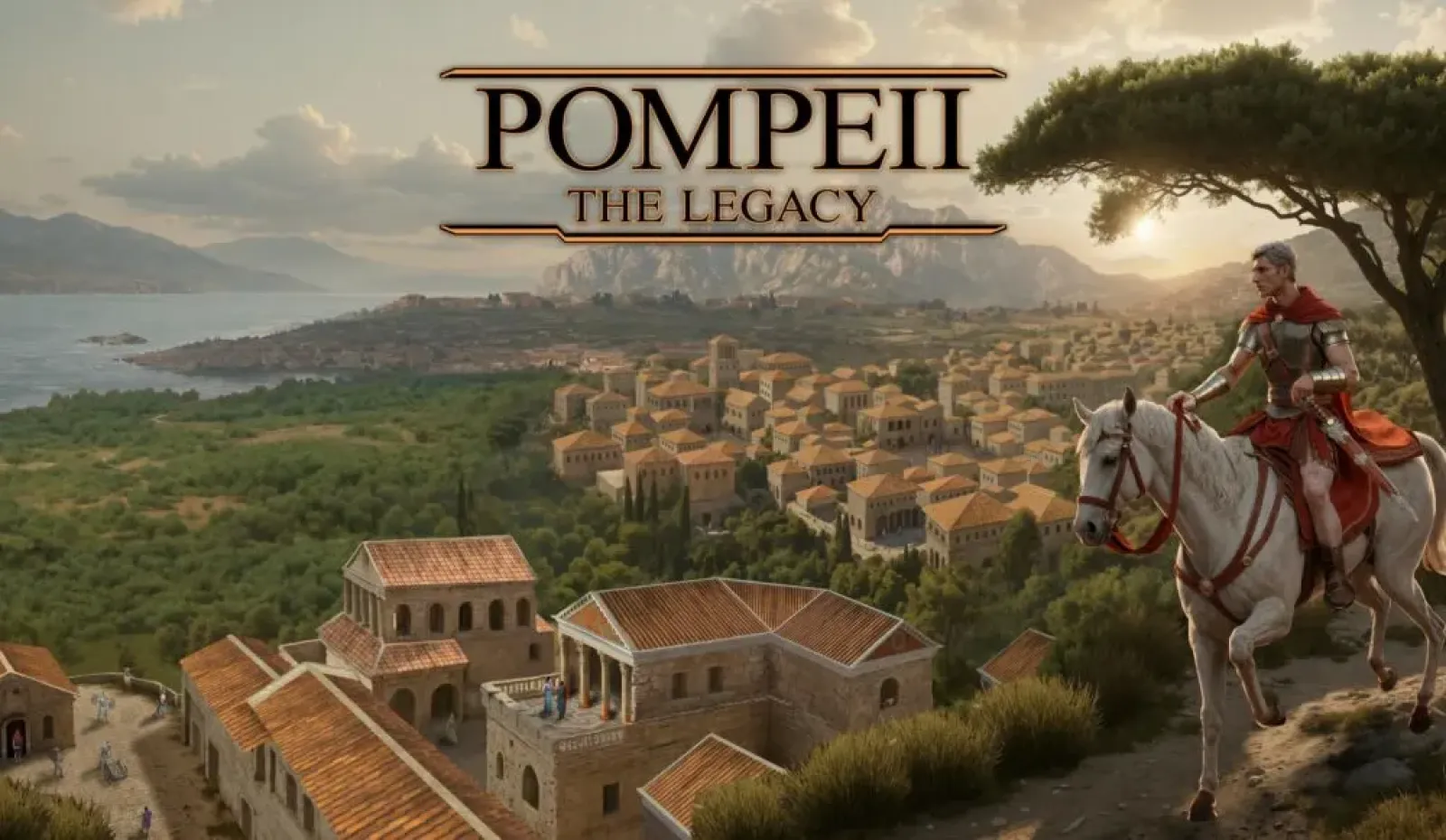
When Pompeii is mentioned, most people will think of the story of the eruption of Vesuvius and the deadly cloud of ash that buried the entire city in 79 AD. While many films and documentaries have focused on that moment of tragedy, the domestic game Pompeii: The Legacy offers a different perspective – what if Pompeii rose again from the ashes? City-builder games have always been a magnet for strategy and history enthusiasts. From old hits like Caesar and Pharaoh to more modern projects like Banished and the Anno series, this type of game has evolved in various directions – some emphasize survival, others economy, and some grand architecture. On that map, the domestic game Pompeii: The Legacy is now seeking its place.
Unlike most games that focus on city building at the height of civilization, Pompeii: The Legacy approaches from a different angle – the rebuilding of Pompeii after the eruption of Vesuvius. So, it is an alternative historical scenario where players not only build and manage resources but also develop a dynasty, enact laws, engage in politics, and try to get the city back on its feet. In addition to standard city-building, the game offers RPG elements – choosing families, heirs, and even arranging marriages for political gain. The flexibility of modes stands out: a campaign for those who want a tutorial introduction, a sandbox for freer development, and a creative mode for those who just want to build without restrictions.
How does it stand against the classics and competition?
- Caesar III/IV – if you are looking for pure Roman city-building focused on meeting the needs of citizens, Caesar is still the model. However, Pompeii adds an extra layer through politics and dynastic management. In short, it offers deeper social and political systems.
- Pharaoh / A New Era – Egyptian grand projects and a rich economy are hard to surpass, but Pompeii tries to offer more freedom and a different atmosphere of recovery after disaster. There are no monumental structures like pyramids, but it provides greater freedom through various modes.
- Banished – the survival aspect of Banished is ruthless, while Pompeii is milder in that regard, but shares a similar philosophy of balancing resources and community survival.
- Anno series – the complex production chains and global trade in Anno games are even more developed, but Pompeii focuses on a smaller, more personal level of the city and its people.
In other words, the game occupies a niche between historical building and dynastic simulation, which is a rarity in this type of game.
Building, politics, and family in the same game
At first glance, Pompeii: The Legacy indeed resembles well-known building classics like Caesar or Pharaoh. You build houses, roads, aqueducts, and markets, taking care of food supply, health, and the safety of citizens. However, after just a few hours of gameplay, it becomes clear that there is an additional layer hidden here.
Namely, the game does not stop at economy and resources. It introduces you to the political-social system of Pompeii, where as a leader you enact laws, decide on taxes, and balance the interests of wealthier and poorer classes. Additionally, there is a dynastic aspect – you choose a family (which ages over the years and their portraits in the game change accordingly), develop heirs, and arrange marriages for benefit. These decisions are not merely cosmetic, but can have long-term effects on the stability of the city, and rival families seize the opportunity for sabotage.
An additional plus is the variety of gameplay modes:
- Campaign serves as an introduction and tutorial
- Sandbox offers freer gameplay with a framework story
- Creative allows for completely relaxed building without restrictions
Visual and Historical Atmosphere
Graphically, Pompeii: The Legacy is not on the level of AAA titles, but it doesn't try to be. The city is vibrant enough to convey the atmosphere of ancient Pompeii, and the music and architecture contribute to the historical ambiance. It is particularly pleasing that the game is localized into Croatian, making it more accessible to a wider audience here and in the region. I tried the game in Croatian and must admit that the terms are very well defined, and nothing sounded strange to me at any moment; my native language immediately "clicked," despite the already "entrenched" English language in gaming among Croats. It is also worth mentioning the voice acting, which was performed quite correctly.
Conclusion
Pompeii: The Legacy positions itself between the historical charm of Caesar and the survival challenges of Banished. It offers enough classic city-building elements to satisfy veterans of the genre, but also enough new ideas – like the dynastic system and legislation – to stand out in the market. Although it is still in Early Access and awaits balance adjustments as well as the development of military and diplomatic systems, it is already clear that this is a title that could find its audience among fans of ancient strategies, as well as among those who want to support local production. The game is backed by Siscia Games, or rather one man – Željko Kos, who dared to step into the demanding genre of city-builders and offer something new. The result is an interesting combination of classic building strategy, RPG elements, and an alternative historical scenario. Pompeii: The Legacy is a bold project that manages to offer something new in this type of strategy. The combination of construction, politics, and family stories gives the game a unique identity, while the historical atmosphere of Pompeii makes it unique enough to stand out from the crowd. It is positive that the developer actively communicates with players and plans regular updates. The potential is there, and what will come of it will depend on community support and persistence in development.
It is not perfect – graphically it is modest and there are some unpolished A.I. artworks, resource balance needs refinement, and the military aspect is still waiting for proper implementation – but despite everything, it already offers hours of fun for strategy and building game enthusiasts.
For all who love ancient themes, want to support local development, and don’t mind some unfinished parts characteristic of Early Access, this is a title worth attention. The game is available for PC on Steam.
A copy of the game for review purposes was provided by Mr. Željko Kos (Siscia Games)