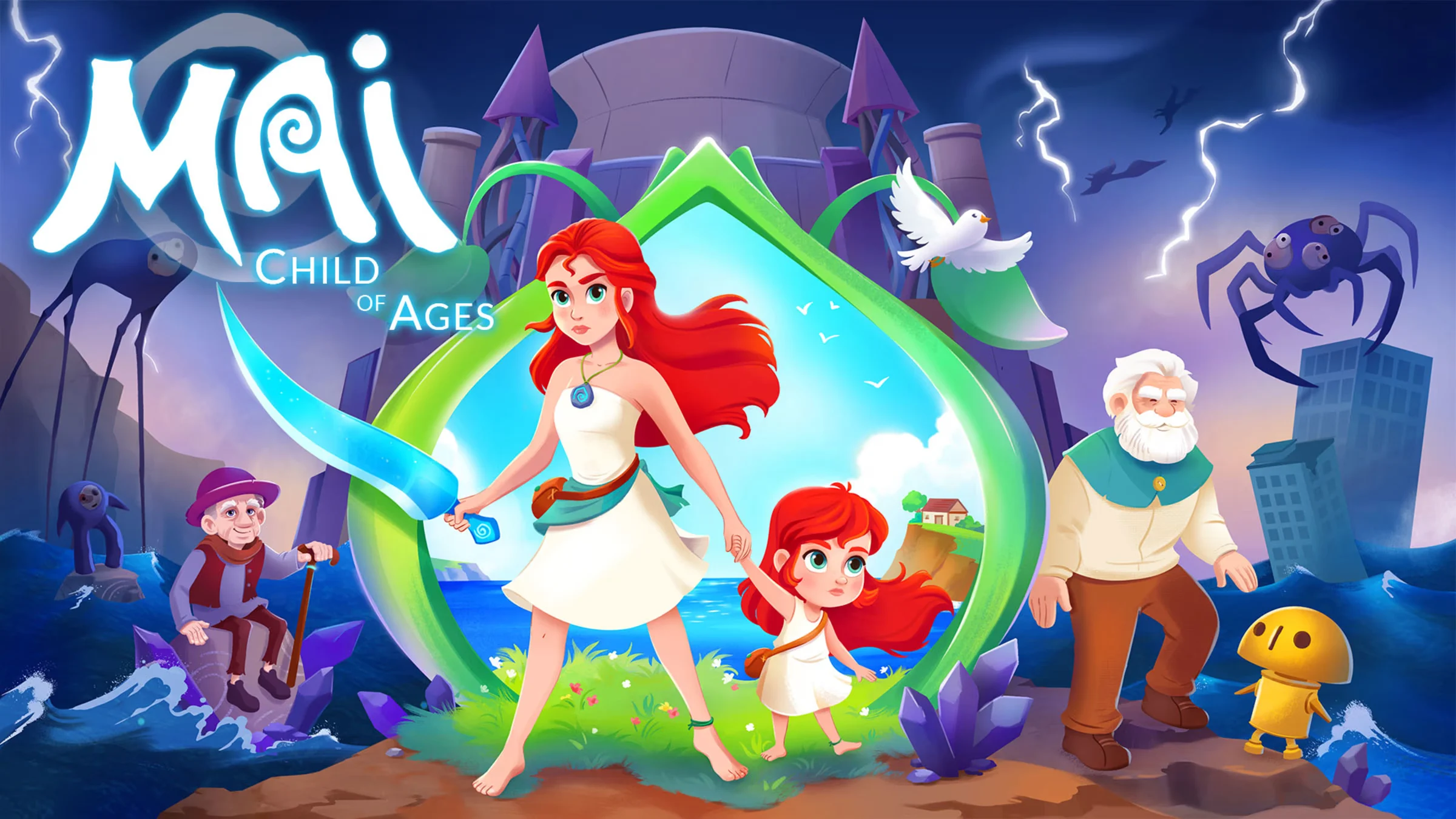
Chubby Pixel was previously known for indie games such as Suicide Guy, Heaven Forest, Heaven Island and The Deer. Most people are not really familiar with their work because so far it has mostly been about some smaller projects. However, we have just received their most ambitious product to date: Mai: Child Of Ages. The game, whose name bears the unusual name of the main character, the little girl Mai, was in the making for the last 5 years and appeared in late September and early October on all platforms. It's an open-world adventure game with Zelda-like gameplay with a much smaller world and correspondingly less exploration, but still interesting and varied enough to keep the player in front of the screen for hours.
Let's start with the story itself. Mai is a red-haired little girl who lives a country life with her grandfather in a lonely house on a farm. The game begins with small quests given to her by her grandfather, such as "Gather wood for the fire" and "Bring the stray goats behind the fence". Mai's adventure begins when Grandpa falls into bed and Mai is forced to explore the island alone to find a cure for Grandpa. We can say that then the game itself begins, exploring the island, discovering new locations, meeting various enemies, and the most interesting element - discovering the possibility and close connection with an older version of yourself, that is, Mai from the future. In the game, there is an interaction between these two worlds, which are closely related, and each world carries its own advantages and disadvantages in a joint attempt to find a solution to all the adversities that are coming. Mai discovers that the salvation of her island (the world) is in her hands. The combination of the game in two worlds that connects the present and the future is definitely a dynamic and interesting element in the game that makes you think and find your way in space.
The gameplay is formed from the third person so that little Mai jumps, solves various puzzles, collects plants that in her hands, depending on the color, emit weapons, a small inflated jumping jack for jumping over gaps or a bomb with which she kills enemies and destroys obstacles on the way. In the future, the world has been changed, a dark dystopian reality surrounds Mai, she gets a sword and a shield and defends herself from various evil forces and tries to save her grandfather and bring the world around her into balance. Time is no longer a constant, but Mai uses the Uroboro stone and magical plants to distort its course and change everything that led to the victory of evil on Earth.
Both characters, the Mai of the present and the future, have different abilities and limitations. Adult Mai cannot jump, but her gameplay is reduced to dodge-block-attack type fights. Also, her gameplay involves solving (even more interesting puzzles) and using a stone that stores progress in that world, so that progress remains in the past that little Mai can use to progress in her world. While little Mai's progress automatically remains adult like the passage of time. Their cooperation is essential for achieving common goals.
In both cases, Mai collects various flies, butterflies, plants, corals, crystals and other resources with which she improves the character in the utility room (toolbox) behind her grandfather's house, and weapons from the seller who waits in specific places in the zones. In order to gain access to the zones that come later in the game, you need to craft some things such as a stone that allows Mai to go to the desert in high temperatures or a stone to walk freely in the cold.
When he finishes exploring the first island, the game continues by exploring the world beyond it. Mai takes a small sailboat and sails the sea, visits other islands, discovers new locations and challenges. Given that Mai has limited movements at the very beginning of the game, the lack of activities such as swimming, diving, destroying armored enemies, after passing a new segment of the game, new possibilities for the character and improvements in movement are unlocked. Also, apart from the sword, which was the only weapon until then, boomerangs and bows and arrows also appear, which open up a new range of possibilities. For other improvements in the toolbox and at the seller, you need to farm the specified resources that respawn in known locations. During the development of the story, segments are occasionally inserted in which the player in the role of another character discovers what led to the dark future. After that, the player returns to the role of Mai and continues the adventure.
The combats in the game are not overly difficult, although sometimes they require quick movement and tactics, and not just hand-to-hand. Losing a life in the game is not a big obstacle. After you die, you simply spawn nearby, and you don't have to kill already solved enemies or solve puzzles again. The skill tree can be opened at any time, but it cannot be modified, it only shows the collected skills. As for quests in general, some tasks are not clear, nor are their instructions. The description of a quest like "Save Grandpa" doesn't leave the player much choice other than to find your way around and try every part of the map. Therefore, it is quite confusing and undefined. The instruction can be clearer as well as additional information about the direction of movement. It is desirable that there is at least a mini-map in the game (which is also absent in this game) or the ability to zoom the large map into segments for easier movement and a compass for better navigation. This way, most of the time you may not know where you are or where to turn. Side quests are also missing, because some activities around the area are reduced to your own research and puzzle solving, which at the end rewards you with a flower that gives +1 to running, jumping, swimming and other statistics. This lack of resourcefulness in space will probably turn a lot of players away from the game itself after a few hours of playing, because they will get bored of wandering around aimlessly. An example is when you go around your home island, it doesn't show you anywhere that the map will expand when you sail off the island and explore further so you might waste a lot of time bending time and trying to collect resources on the first island because it doesn't tell you where to go in search of grandfather's medicine. For perfectionists who want 100% of the game, there will also be a problem because the things you collect are not really shown anywhere on the map and you will have to look in every corner of the world to find them. Another, and in my opinion, the biggest minus of the game is the fast-burning stamina. It is used up while running, climbing, swimming or diving. So you will often run towards the cliff to start climbing and very quickly the character will fall because you have already drained all your stamina just by reaching the cliff. Mai can swim very little and when her stamina runs out, she drowns and respawns on a nearby shore. This quick consumption of stamina limits the player to better explore the world and find something interesting.
Also, one of the additional but unnecessary things in the game is co-op play. This is not a classic co-op game, but the second player assumes the role of the enemy during the fight and thus helps Mai, that is, the first player to overcome her. It is an option that most players probably won't even use, because the experience with one player is quite enough.
As for the graphics themselves, the look is cartoonish. Mai herself looks a bit like Disney's Ariel, the faces of the black ghosts that the grown-up Mai confronts look like the ghost from Studio Ghibli's Spirited Away, and the world is interestingly and dynamically made. The game was tested on Nintendo Switch 2, on which the game runs at a nice 60 fps, however, it is full of holes in the graphics in which the main character passes through certain objects such as bushes or rocks, sometimes falls through the floor and is nowhere to be found, and the only solution is to return to the fast travel point, i.e. the plant. You won't even see certain objects or islands until you get close to them and they just mysteriously appear. Therefore, the lack of visual information in the course of the game prevents the player from figuring out for himself what the next step is.
One of the better elements of the game that pleasantly surprised me is the quality soundtrack, which is fantastic and consistent with the dynamics of the game. Light music while Mai explores the islands, tense when the fight starts, masterful as we discover a new world. I can also single out the quality of the sound, which is clear, strong and pleasant in the game.
The duration of the entire game is about 20 hours, counting some research and solving the main story, but for most it will take much longer if they get stuck on certain puzzles or don't know how to proceed. All in all, if we exclude the technical difficulties, the undefined tasks, that is, the lack of information related to them, and the confusion in the space, it is a very interesting game that is worth playing. Definitely a great departure from the previous Chubby Pixel games we've seen. Although the overall performance could have been much better, we can say that they are on the right track. Therefore, we can hope that their next project will be an even better step forward in the quality of the game, as we have witnessed now and convinced ourselves that it is very possible to make it.
A copy of the game was provided by the development studio ChubbyPixel for review purposes