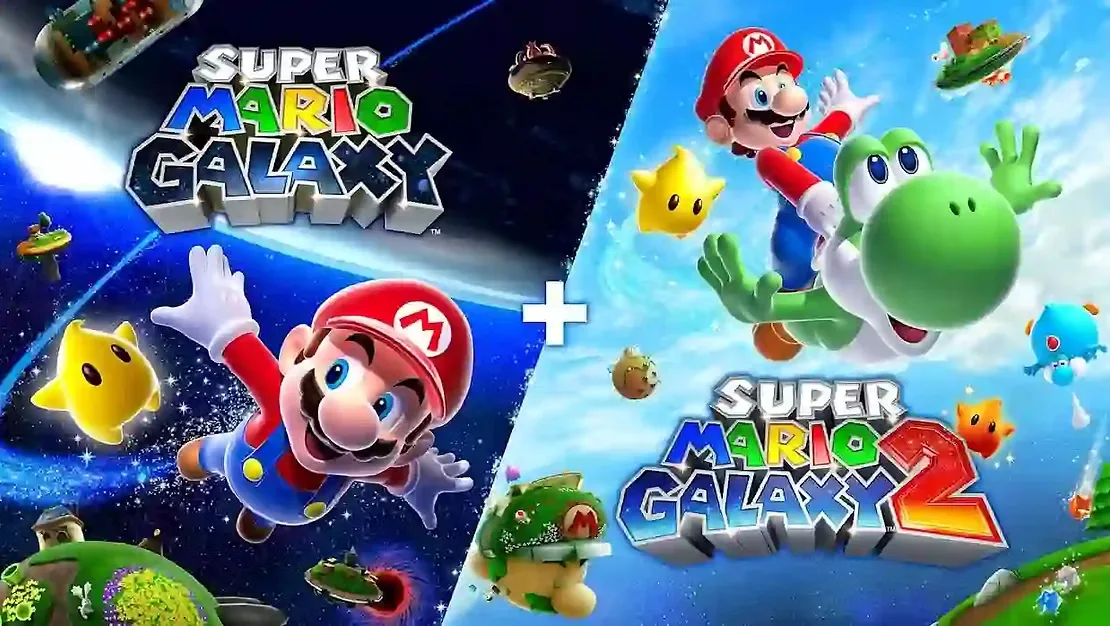
The year is 2006, and Nintendo released a console noticeably weaker than the then Xbox 360 and Playstation 3, but that didn't bother anyone. The Wii was an instant hit, and soon after it was released Super Mario Galaxy, the new 3D flagship, and its crown jewel.
The game conquered the world: precise motion controls, fresh mechanics, a perfect balance between nostalgia and innovation, yet addictively fun. Just three years later, Galaxy 2 arrived, even smoother, richer and more polished, which added everyone's favorite digital friend: Yoshi. oshiya.

Galaxy, be careful! Mario is coming
Coming to 2020, Nintendo tried to capitalize on that nostalgia by releasing Super Mario 3D All-Stars, the kit they made up Super Mario 64, Sunshine and Galaxy, but with a controversial move. That collection was available in limited quantities, both physically and digitally, so many, including myself, were left with short sleeves.
Five years later, we finally have what we've been waiting for: a remaster of both Galaxy games, available for Switch and Switch 2. The only question is: does this stellar adventure hold up, or has the years gotten the better of it?

Each planet has its own theme and character
When the fairy tale goes into orbit
Galaxy is the first Mario to turn the classic story of the kidnapping of Princess Peach into a space fairy tale. This time, Bowser uses the power of the stars, or Luma beings, to conquer the entire universe (don't worry, he still kidnaps Peach). For the first time, we meet Rosaline, the mysterious protector of Lum and guardian of the universe, who shelters Mario on her flying star station. Mario must collect stolen stars, the Power Stars, to restore the Observatory's energy, unlock distant galaxies, and ultimately save Peach.

One small planet for big people
Through the game, you also discover her past through Rosaline's storybook, a series of chapters that follow her childhood, traveling through space and creating a family with the Lums. That melancholic, quiet story gives it an emotional depth that the Mario universe didn't have until then. The new Switch edition brings a new chapter to that story.

Just be careful not to fall into a black hole.
Gameplay and gravity
The game can be played in handheld or docked mode, but I recommend playing it on the big screen with a split Joy-Con just like I used to with the Wiimote and Nunchuk. Motion controls are used to collect Star Bites, star debris that you can feed to Lumas, which then transform into new stars or planets. You can also shoot enemies with bites to stun them.
When you shake the right Joy-Con, Mario activates a Spin Attack, but now it can also be activated with a button. You can also shake the entire Pro Controller and move the cursor with it. It's a little less intuitive than the Joy-Con, but you get used to it quickly. In handheld mode, you control the cursor by moving the entire device, which is a bit impractical, but you can also use touch controls.

Drilling to the core of the planet!
Mario jumps, spins and uses numerous new transformations: Bee Mario, Spring Mario, Boo Mario… the transformations add mini-twists and make each level fresh. Each galaxy is a collection of small planets that Lumes launch you between. Some will have you walking on the surface of an entire small planet, and others are large enough to be a real small world.

The last star of the level usually ends with a mini boss fight
Gravity is the main player: the camera is fixed and constantly follows you, the orientation changes, and Mario often runs upside down, jumps from one planet to another and adapts to new laws of physics, which never stops being fun. The goal of each level is to collect a gold star, as star power powers Rosaline's observatory and enables travel to further reaches of the galaxy. Each level has several of them, and the last one usually represents some kind of boss fight.

The levels are presented as small galaxies that we progressively unlock
Mario's movements are more limited compared to other games, as if he is floating, which goes with the space theme. Levels are more linear compared to Mario 64, Sunshine or Odysseus, the camera is mostly fixed, with limited rotation. Everything is carefully choreographed and he knows exactly what he wants from you. While other titles give more freedom, I would say yes Galaxy gives a stronger presentation.

Mario is finally appreciated as he deserves
Galaxy 2: faster, crazier and more precise
Galaxy 2 is not just a sequel, but a step forward. Bowser returns, this time even bigger, scarier and crazier, and Mario sets out on a quest with his own spaceship fashioned in his image and opportunity. While the unit is fairy-tale, the deuce is more focused on pure precision and playability. Each galaxy is distilled to perfection – introduce a new mechanic, work it through two or three iterations and throw it away. The levels are shorter, but more challenging and creative. The camera is more precise, the cutscenes are shorter and the pace is almost perfect.

That infinity... and beyond?
The biggest addition? Yoshi. He is not a constant companion, but when he is there, everything revolves around him. He uses his tongue to grab enemies, can inflate himself and fly, dash up hills or discover hidden platforms in dark spaces. All Yoshi levels are tailored to his skills and act as a mini-game within the game. It's hard not to love Yoshi.

In Galaxy 2, the transition between levels is much more fluid and linear
Galaxy 2 also brings new transformations: Cloud Mario is a cloud platform thing and adds even more to the vertical design, and Rock Mari rolls and destroys everything in front of him. Galaxy 2 it may have a less fairy-tale atmosphere, but it absolutely excels in the precision and variety of gameplay.

Yoshi and I, on the wings of the stars!
Better than ever, but still the same old Galaxy
On the Switch 2, both titles run in 4K resolution, with slightly improved textures and better lighting effects, but these are still more or less the same games as on the Wii. If you look more closely at the characters, you will notice sharper polygons. However, the timeless graphic style holds up well, and this is the best it's ever been Galaxy ever looked. The cutscenes, admittedly, are left over from the Wii era, and with their graininess, they act as a punch to the eye in the middle of crystal clear gameplay sections.

Menus have been redesigned, more transparent and adapted to modern standards. There is an option to activate Assist mode, which doubles health and returns Mario to a safe place after falling from a platform. Sincerely? You don't need that. I recommend playing standard mode. It has more weight and satisfaction. Local co-op is also available: a second player collects Star Bites with a Joy-Con and helps shoot, but unless you're playing with a small child, I don't see too much fun in it.

Winning a star is a nice feeling and never gets boring

Soundtrack? Top. It's no surprise that Galaxy themes are a frequent guest on chill YouTube playlists. They are definitely among the best in the entire franchise. From Rosaline's waltz to the Gusty Garden Galaxy theme, the feeling of flight through space, exciting exploration and quiet existence is created. In each galaxy, a combination of silence, loneliness and pure joy is felt. Each planet has its own character, its own physics and soundscape. Everything seems carefully designed, with a touch of poetry. That feeling of exploring the universe out of pure curiosity, despite the years, has not been lost. In fact, it's even easier to appreciate it now. These games were ahead of their time, and still are.
The stars still shine, they're just a little more expensive
70 euros for the bundle, 40 per game. For games almost 20 years old. No wonder the Internet is a bit outraged. These are undeniably top-notch games, but Nintendo hasn't put too much effort here, and they're selling them at the price of a new title. If you don't have a Wii, you're screwed 3D AllStars, this is your only chance to (legally) play the new, better version of Galaxy. If you've never played it, it's definitely worth it, even though it's not fair. I think Nintendo could have comfortably asked for 40 euros for the whole bundle. Yes, it looks beautiful and the nostalgia hits, but paying 70 euros for a feeling you've already experienced? A difficult dilemma.
These games are still masterpieces of design and imagination. Playing them is never boring. They haven't lost their charm, rhythm or elegance, but they have lost that first surprise. Nintendo knows very well how to sell nostalgia, and it does it shamelessly well. If you can swallow that, you'll be treated to some of the best platforming games of all time, in their purest, smoothest form. I definitely enjoy the games, but if I've played them before… I'm not sure if I'd shell out 70 euros again for the same ride, even in 4K.
A copy of the game was provided by the distributor CD Media for review purposes