A long time ago in 1993, in the midst of challenging war times and modest computing resources, appeared Sraz – an educational computer game that went down in history as the first homemade video quiz knowledge The game was developed by a Zagreb company 32 bits d.o.o. led Big Kukulja, creator of the most successful Croatian games of that era. From the very beginning, Sraz emphasized its patriotic stamp and innovation: it was that multiplayer quiz-social game intended for elementary school students, with which students could check and determine school material through fun. At a time when Croatian homes were dominated by foreign games (often obtained through pirate channels), Sraz attracted attention as domestic product – he played just as much out of love for quizzes as out of pride in what he was doing Croatian game.
Game concept: "Knowledge fight" on the board
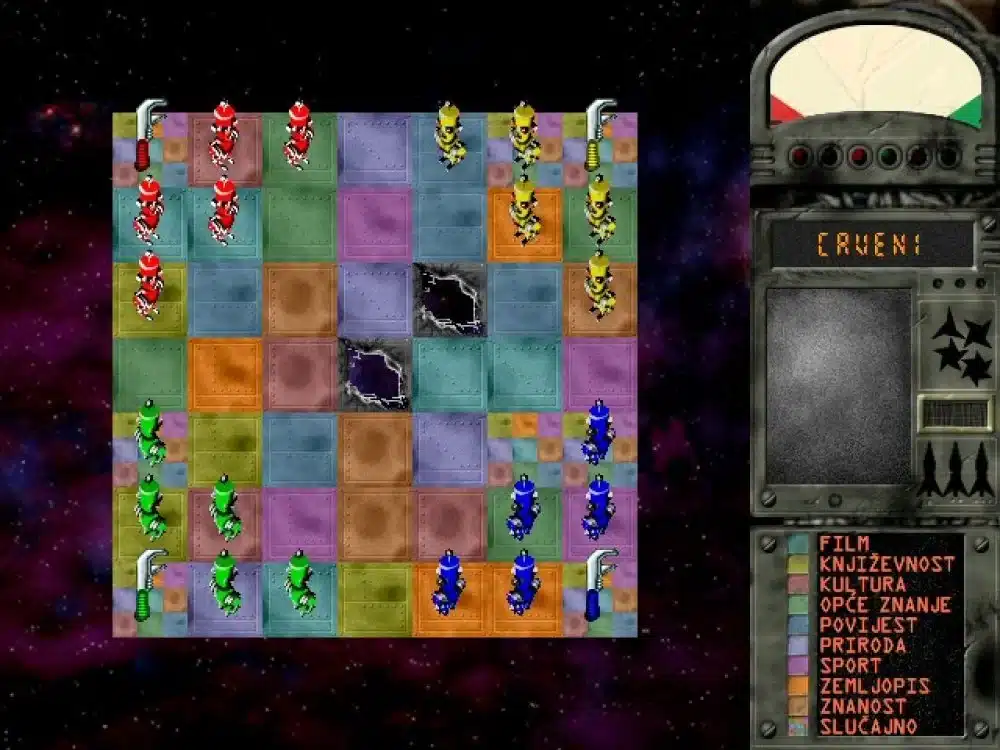
Sraz is conceived as board game for 2 to 4 players located on a virtual board divided into fields of various topics. Each player starts with pieces (pawns) and his flag in the corner of the board, and the goal is by answering questions eliminate rivals and win their flags. Fields on the board are marked with categories of knowledge - from sports, history, geography and nature to music, art, science and general knowledge. Some fields are marked "Random", which means that the question can come from any category, further testing the breadth of the player's knowledge. When you stand on a certain field, the game places you question with four possible answers from the appropriate field; a correct answer allows the piece to move to that space, while an incorrect one means the pawn stays put.
The special charm of Sraz was that it was introduced into the classic quiz strategic component. The game rewards a series of correct answers: any pawn that five times in a row if he guesses correctly, he is "promoted" to a higher rank - from the initial "serf" to "soldier", then to "knight". A higher rank provides a tactical advantage because it allows that pawn to move an additional space forward, which speeds up the board's progress. Also, if the piece is on the same field as the opponent, it occurs "sraza" - a duel with knowledge. In a duel, both players must answer two new questions correctly; more successful "attacker" thereby pushing the opponent back and lowering his rank (or removing him from the board if he was already at the lowest rank), while an incorrect answer from the attacker results in the loss of his rank. This combination of quizzes and board game mechanics made the game tense and unpredictable, combining knowledge with tactics. The game contained a total of approx 1000 questions in the base, covering a wide range of elementary school teaching material, so the players are unnoticeable learn while competing.
Development, platforms and distribution
Behind Sraz was a small enthusiastic team 32 bits, founded in 1993 with the mission of developing innovative educational concepts using new technology.. The game was first published for PC (MS-DOS) platform, and a version for Commodore Amiga computers, which was a noteworthy undertaking considering the limited resources of the domestic industry. It spread through the usual channels at the time - from diskettes that circulated among students and IT sections of schools, to the first computer magazines. It is interesting that mass piracy didn't hold back Sraz - in fact, the copies made it possible for the game to reach a much wider audience than classic commercial distribution could at the time. It is estimated that Sraz played through various editions over 200,000 people – an impressive figure for the domestic game of that period. Although primarily designed for schoolchildren, Sraz also found its way to adult quiz lovers, cementing its status as a cultural phenomenon in the nascent Croatian gaming scene.
Legacy and status in the retro scene
Sraz did not remain just a one-time hit - over the years it grew into the whole series. There were specific editions under the name "School meeting - fight with knowledge" for each grade from 3rd to 8th elementary school, adapted to their curriculum. A total of ten versions and sequels were published, including thematic variants - for example, a later edition "Stock Market Summit" dealt with the world of the stock market and finance through the same quiz format. Over time, Sraz followed technological progress: in the late 90s and 2000s, it appeared on CD-ROM editions, and until its 20th anniversary it also underwent a modern renovation. In 2013, the 32 bit team launched School Meeting as a number of applications for smartphone, tablet and Smart TV platform, with which this game of knowledge has stepped into the digital age of new generations. In this way, the twentieth anniversary of the release of Sraz - the first Croatian computer game - was symbolically marked by connecting old educational ideas with new technologies.
Today, with the passage of time, Sraz enjoys status cult classic within the Croatian retro gaming community. It is often referred to as the foundation of the domestic video game industry and one of the most memorable vintage titles ever made "by the hands of the wrestling regiment". His formula "learning through competition" remained a unique memory for many generations who grew up in the 90s. At gatherings of retro gamers, Sraz evokes nostalgic smiles - it evokes the time when friends and family used to gather around the computer, turning learning material into fun. "the fight with knowledge". In a broader context, Sraz's success paved the way and gave the wind behind the development of other educational projects (such as the series Sunshine same team). Although technological progress has overtaken him, historical significance of Sraz remains unquestioned - even today he stands out with respect as a pioneer who showed that even in difficult times a game of what will happen can arise combine fun and knowledge, and become part of Croatia's digital heritage.